Example 1: Evaluating a 3 × 3 determinant
Evaluate the determinant with rows (1, 2, 3), (0, 1, 4) and (5, 6, 0).
1 × [(1)(0) − (4)(6)] = −24−2 × [(0)(0) − (4)(5)] = 403 × [(0)(6) − (1)(5)] = −15−24 + 40 − 15 = 1
Answer: 1
A 2 × 2 determinant is ad − bc. A 3 × 3 determinant is expanded along a row: each entry is multiplied by the 2 × 2 determinant left when its row and column are removed, with signs + − +. In M2 determinants are used to find inverse matrices and to solve systems of linear equations.
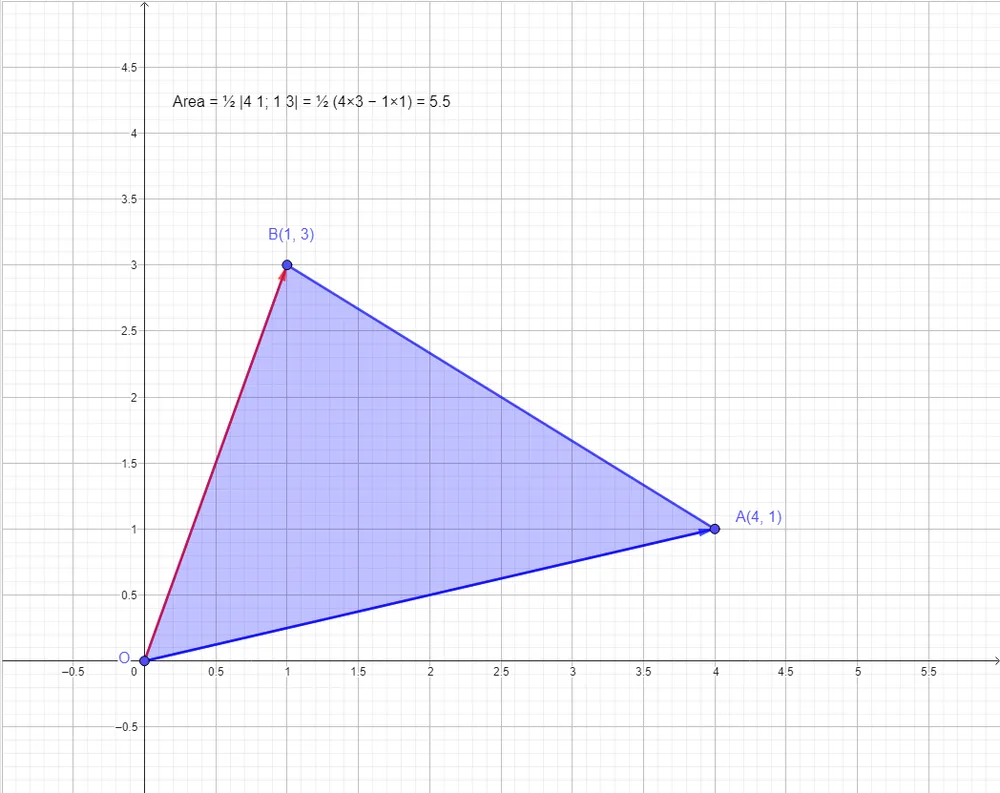
|a b; c d| = ad − bca₁₁(a₂₂a₃₃ − a₂₃a₃₂) − a₁₂(a₂₁a₃₃ − a₂₃a₃₁) + a₁₃(a₂₁a₃₂ − a₂₂a₃₁)|A| or det A|A| = 0 ⟺ A has no inverse½ |a b; c d| for A(a, b), B(c, d) taken anticlockwiseEvaluate the determinant with rows (1, 2, 3), (0, 1, 4) and (5, 6, 0).
1 × [(1)(0) − (4)(6)] = −24−2 × [(0)(0) − (4)(5)] = 403 × [(0)(6) − (1)(5)] = −15−24 + 40 − 15 = 1Answer: 1
Find the values of k for which the determinant with rows (k, 1, 1), (1, k, 1) and (1, 1, k) equals 0.
k(k² − 1) − 1(k − 1) + 1(1 − k) = k³ − 3k + 2k³ − 3k + 2 = (k − 1)(k² + k − 2) = (k − 1)²(k + 2)(k − 1)²(k + 2) = 0Answer: k = 1 or k = −2
+ − +. Forgetting the minus on the second term is the usual reason a 3 × 3 determinant comes out wrong.How to study: Click any question below to instantly load it on the coordinate grid and check your steps.