Differentiation (DSE M2): Rules, First Principles and Implicit Differentiation

The derivative dy/dx is the limit of [f(x + h) − f(x)] / h as h → 0: the slope of the tangent. In DSE M2 you differentiate with the product, quotient and chain rules, and you are also expected to differentiate from first principles, implicitly and by logarithmic differentiation.

Solve Differentiation questions with AI
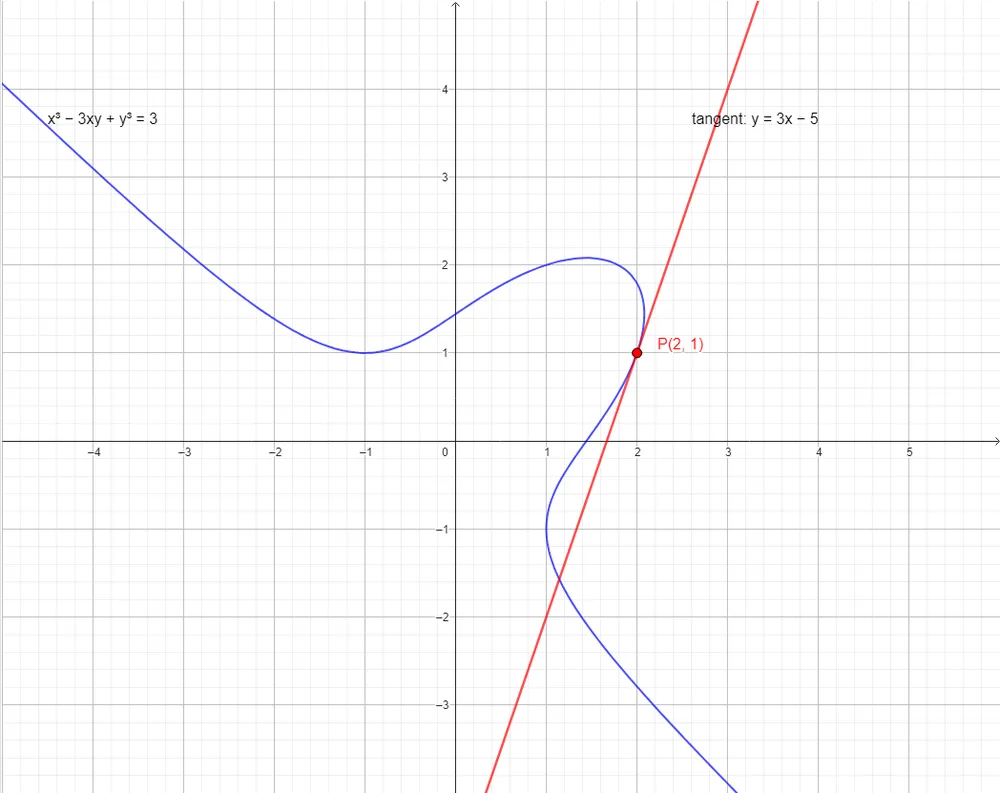
GeoGebra graph of the implicit curve x cubed minus 3xy plus y cubed equals 3 with its tangent line at the point (2, 1)
The curve x³ − 3xy + y³ = 3 and its tangent y = 3x − 5 at (2, 1), from Example 1. Try it yourself →

Differentiation Formulas (DSE M2)

First principlesf′(x) = limh→0 [f(x + h) − f(x)] / h
Power, exponential, logarithm(xⁿ)′ = nxⁿ⁻¹, (eˣ)′ = eˣ, (ln x)′ = 1/x
Trigonometric(sin x)′ = cos x, (cos x)′ = −sin x, (tan x)′ = sec² x
Product rule(uv)′ = u′v + uv′
Quotient rule(u/v)′ = (u′v − uv′) / v²
Chain ruledy/dx = (dy/du)(du/dx)
Other bases(aˣ)′ = aˣ ln a, (loga x)′ = 1 / (x ln a)

Implicit Differentiation: Step by Step

  1. Differentiate both sides with respect to x.
  2. Every time you differentiate a term in y, multiply by dy/dx: d(y³)/dx = 3y² · dy/dx.
  3. A term such as xy is a product: d(xy)/dx = y + x · dy/dx.
  4. Collect the dy/dx terms on one side and factorise.
  5. Substitute the point only at the end.

Use logarithmic differentiation when the function is a long product or quotient of powers: take ln of both sides, simplify with the log laws, differentiate implicitly, then multiply by y.

Worked Examples — Differentiation

Example 1: Implicit differentiation and the tangent at a point

A curve is given by x³ − 3xy + y³ = 3. Find dy/dx and the equation of the tangent at the point (2, 1).

  1. Differentiate both sides: 3x² − 3y − 3x(dy/dx) + 3y²(dy/dx) = 0
  2. (y² − x)(dy/dx) = y − x²
  3. dy/dx = (y − x²) / (y² − x)
  4. At (2, 1): dy/dx = (1 − 4) / (1 − 2) = 3
  5. Tangent: y − 1 = 3(x − 2), i.e. y = 3x − 5

Answer: dy/dx = (y − x²) / (y² − x); y = 3x − 5

Example 2: Differentiation from first principles

Find the derivative of f(x) = √x from first principles.

  1. f′(x) = limh→0 [√(x + h) − √x] / h
  2. Multiply top and bottom by √(x + h) + √x: the numerator becomes (x + h) − x = h
  3. f′(x) = limh→0 1 / (√(x + h) + √x)
  4. f′(x) = 1 / (2√x)

Answer: f′(x) = 1 / (2√x)

💡 Exam Traps & Secrets

⚠️ The missing chain-rule factord/dx (sin 3x) = 3 cos 3x, not cos 3x. After differentiating the outer function, always multiply by the derivative of what is inside.
⚠️ First principles means the limit must be writtenIf the question says "from first principles", using the power rule scores nothing. Write the limit definition, simplify until h cancels, and keep the lim symbol on every line until you take the limit.

✏️ Self-Test: Quick Interactive Practice

How to study: Click any question below to instantly load it on the coordinate grid and check your steps.

(Product and chain rules)Differentiate y = x² e^(3x) sin x.
(Implicit differentiation)Find dy/dx if x² + xy + y² = 7, and the slope at (1, 2).
(First principles)Find the derivative of f(x) = 1/x from first principles.

Frequently Asked Questions

Related Topics

LimitsApplications of DifferentiationIntroduction to eDSE M2: all topicsDSE M2 formula sheetM1 vs M2DSE M1 notesHKDSE Math: all topics
Try a Differentiation DSE Practice Question