SketchMath Solves Deductive Geometry and Circle Centres (With Examples)
Exam-type flashcard: circle centre, tangent, and angle/distance reasoning
Use this as a proof framework and adapt the logical steps to your exact exam question.
Combining coordinate geometry with deductive circle properties is the ultimate "boss fight" in HKDSE Paper 1 Section B. Students are often overwhelmed by a wall of algebra and fail to see the simple geometric shapes hidden behind the equations.
In our March 2026 New Territories geometry workshops, we ran a test: what happens when students use an interactive graph to bridge the gap between their algebra and their geometric proofs?
Tutors observed a massive shift. Students stopped "guessing" which theorem to use and started matching their equations directly to visible objects on the screen. Here is how visual learning untangles the hardest geometry questions.
A Heavy DSE Worked Example: Coordinates Meet Deductive Proofs
Let's break down a notoriously complex Section B problem involving a circle, its tangents, and circumradii.
Part (a): Finding the Circle's Constants
We are given a circle C: x² + y² + ax − 2y + b = 0 that passes through (−10, 9).
Condition of Point: Substitute (−10, 9) into the equation: (−10)² + 9² + a(−10) − 2(9) + b = 0 ⇒ b = 10a − 163
Condition of Tangency: A line y = ¾x + 83 is tangent to the circle. Substituting this line into the circle's equation yields a heavy quadratic: 25x² + (9a + 640)x + (90a + 4924) = 0.
The Discriminant Trick: Because a tangent touches the circle at exactly one point, the discriminant must be zero (Δ = 0). Setting Δ = 0 gives 9a² + 280a − 9200 = 0. Since a > 0, we solve to find a = 20 and b = 37.
Result: The circle C has its center at I(−10, 1) and a radius of 8.
Part (b): Geometric Properties (The Visual Magic)
Instead of doing blind calculations, look at the SketchMath graph. We have a point P(−20, 1) on the tangent line, creating a tangent segment PQ. Let T be the exact point of tangency.
(i) Find cos ∠IPQ: Draw the radius from center I to the tangency point T. This instantly forms a right-angled triangle △IPT (since tangent ⊥ radius). The hypotenuse IP = 10 (using distance formula). The radius IT = 8. By Pythagoras, the tangent length PT = 6. Thus, cos ∠IPQ = Adjacent / Hypotenuse = 6/10 = 0.6.
(ii) Find Distance IQ: We are given the total length PQ = 25. Since PT = 6, the remaining segment TQ = 25 − 6 = 19. Look at the other right-angled triangle, △ITQ: IQ = √(8² + 19²) = √(64 + 361) = √425.
(iii) The Circumradius Check: If circle C is the incircle of a larger △PQR with side lengths 25, 38, and 51, we can use standard area formulas to find its circumradius r. The math yields r = 26.5625. The exam asks to check a claim: is r > PQ? Since 26.5625 > 25, the claim is correct.
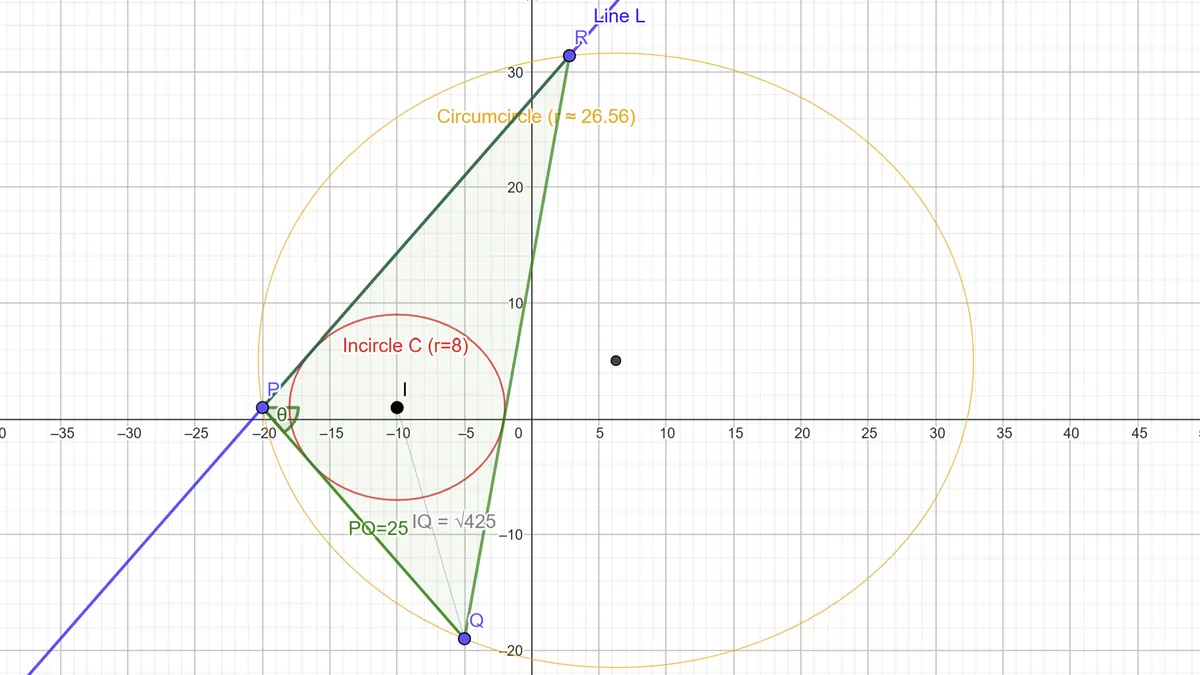
Click the image to explore this question interactively →
10 Steps to Crack Coordinate & Deductive Hybrids
Here is the exact 10-step workflow our top students use to map heavy algebra to geometric proofs:
The Setup
- Extract the center and radius from the general circle equation.
- Set Δ = 0 whenever you read the word "tangent" to lock in your constants.
- Draw a line from the center to the point of tangency to force a 90° angle.
The Execution
- Locate your external points (like P and Q) on the coordinate plane.
- Identify the hidden right-angled triangles connecting the center, the tangency point, and the external points.
- Apply Pythagoras' Theorem to find missing tangent lengths.
- Subtract known segments from total given lengths (e.g., TQ = PQ − PT).
- Read your trigonometric ratios (like cos ∠IPQ) directly off the visual triangle you just built.
The Review
- Map complex final claims (like circumradius comparisons) to your visual diagram.
- Sanity-check your logic by moving valid points on the screen to ensure the 90° tangency rule never breaks.
Why Interactive Graphs Beat Static Notes
1. It connects abstract algebra to physical geometry.
Students often calculate Δ = 0 mindlessly. SketchMath visually shows that Δ = 0 is the exact moment the line physically "kisses" the edge of the circle.
2. Hidden triangles become obvious.
Right-angled triangles like △IPT and △ITQ are incredibly hard to imagine from raw coordinates. Highlighting them dynamically makes steps like finding cos ∠IPQ trivial.
3. It trains clearer proof sequencing.
SketchMath supports theorem-level visual tracing. When students can visually verify that a tangent line forces a 90° angle, their written deductive steps flow in a logical, chronological order, earning them the maximum "Step Marks" (Reasons) in the DSE.
What Students & Tutors Are Saying
“I used to just write random equations and hope they connected. Seeing the center and tangent lines color-coded helped me map the algebra to the actual shapes.”
“Seeing the dependencies — like how finding PT was required before I could find TQ and IQ — made the logic order so much clearer.”
“Because my students could visually trace the tangent line back to the center, their written proofs were much cleaner. There were far fewer jumps between unrelated claims.”