Vector Projection onto a Cross Product: Worked 3D Example

Grades 11-12
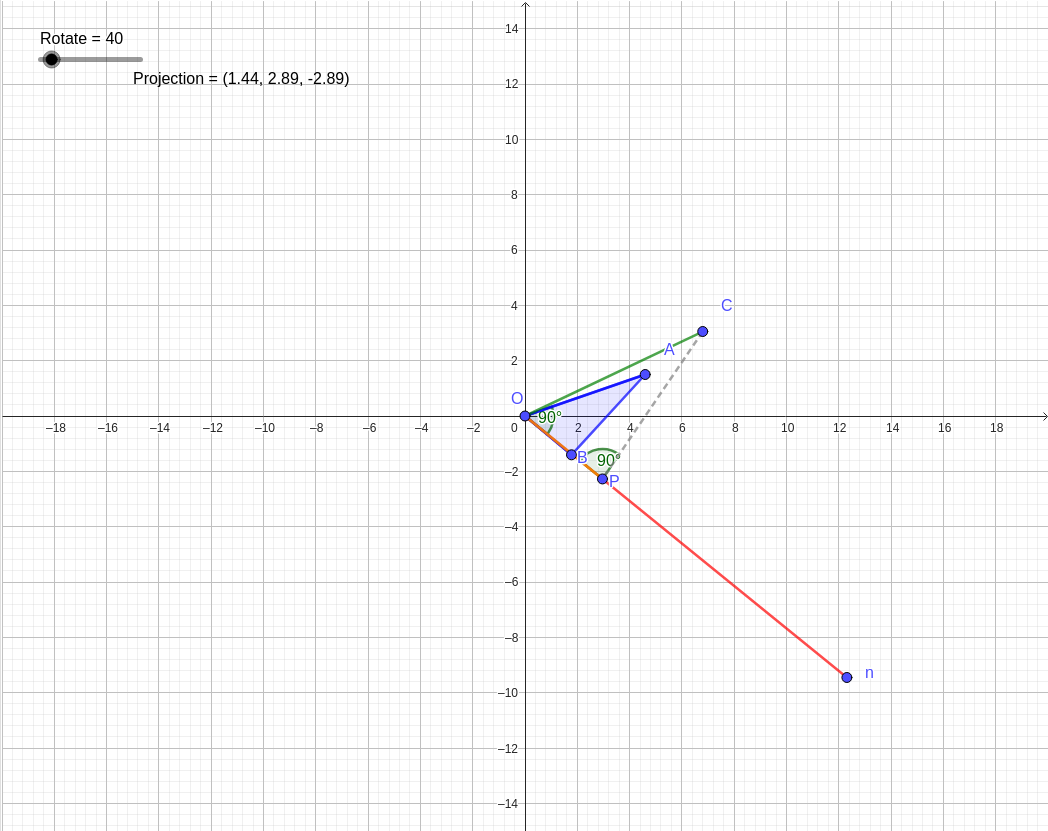
Interactive Vector Projection onto a Cross Product: Worked 3D Example graph — click to explore
Click the graph to explore it interactively →
Question: O is the origin, A=(6,0,3), B=(4,-2,0), C=(3,7,2). Find projection of OC on OA cross OB
To find the projection of vector \vec{OC} onto the vector cross product \vec{OA} \times \vec{OB}, we follow a series of geometric and algebraic steps.
The cross product \vec{n} = \vec{OA} \times \vec{OB} results in a vector that is perpendicular to the plane containing the origin O and the points A and B. In the visual model, this plane is shaded in blue. The vector \vec{OC} (shown in green) is the vector we wish to project. The projection of \vec{OC} onto \vec{n} represents the component of \vec{OC} that points in the direction of the normal to the OAB plane. This resulting projection vector is shown in orange, extending from the origin to a point P on the line of the cross product.

1. Calculate the Cross Product \vec{OA} \times \vec{OB}

Given: \vec{OA} = (6, 0, 3) \vec{OB} = (4, -2, 0)
The cross product is calculated using the determinant: \begin{align*} \vec{n} &= \vec{OA} \times \vec{OB} = \begin{vmatrix} \mathbf{i} & \mathbf{j} & \mathbf{k} \\ 6 & 0 & 3 \\ 4 & -2 & 0 \end{vmatrix} \\ \vec{n} &= \mathbf{i}(0(0) - 3(-2)) - \mathbf{j}(6(0) - 3(4)) + \mathbf{k}(6(-2) - 0(4)) \\ \vec{n} &= \mathbf{i}(6) - \mathbf{j}(-12) + \mathbf{k}(-12) \\ \vec{n} &= (6, 12, -12) \end{align*}

2. Calculate the Dot Product \vec{OC} \cdot \vec{n}

Given: \vec{OC} = (3, 7, 2) \vec{n} = (6, 12, -12)
The dot product is: \begin{align*} \vec{OC} \cdot \vec{n} &= (3)(6) + (7)(12) + (2)(-12) \\ \vec{OC} \cdot \vec{n} &= 18 + 84 - 24 \\ \vec{OC} \cdot \vec{n} &= 78 \end{align*}

3. Calculate the Magnitude Squared of \vec{n}

\begin{align*} |\vec{n}|^2 &= 6^2 + 12^2 + (-12)^2 \\ |\vec{n}|^2 &= 36 + 144 + 144 \\ |\vec{n}|^2 &= 324 \end{align*}

4. Find the Vector Projection

The formula for the projection of \vec{u} onto \vec{v} is \text{proj}_{\vec{v}} \vec{u} = \left( \frac{\vec{u} \cdot \vec{v}}{|\vec{v}|^2} \right) \vec{v}. Let \vec{p} be the projection of \vec{OC} on \vec{n}: \begin{align*} \vec{p} &= \frac{78}{324} (6, 12, -12) \\ \vec{p} &= \frac{13}{54} (6, 12, -12) \\ \vec{p} &= \left( \frac{13 \times 6}{54}, \frac{13 \times 12}{54}, \frac{13 \times (-12)}{54} \right) \\ \vec{p} &= \left( \frac{13}{9}, \frac{26}{9}, -\frac{26}{9} \right) \end{align*}
The projection of \vec{OC} on \vec{OA} \times \vec{OB} is the vector \left( \frac{13}{9}, \frac{26}{9}, -\frac{26}{9} \right).
vectorscross-product3d-geometry