Angle Between Two Planes in a Tetrahedron (3D Trigonometry)
Grades 11-12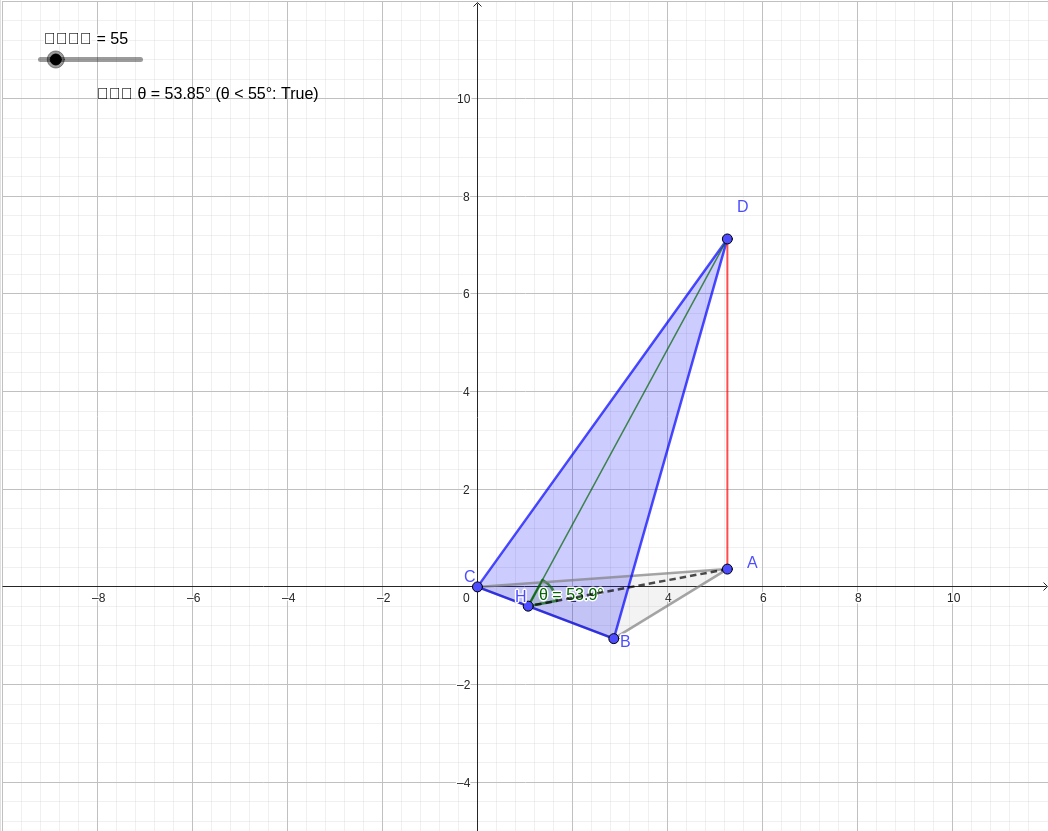
Question: Given triangle ABC with AB = 6 cm, BC = 5 cm and angle ACB = 70 degrees. DABC is a tetrahedron in which DA is perpendicular to plane ABC, and DA = 7 cm. A student claims that the angle between plane DBC and plane ABC can exceed 55 degrees. Do you agree? Explain your answer.
To determine whether the angle between plane
and plane
can exceed
, we need to compute the exact value of this dihedral angle using geometric principles.
1. Locating the Dihedral Angle
- Line of intersection: plane and plane meet along .
- Construction: draw a perpendicular from point to line , meeting it at , so .
- Three Perpendiculars Theorem: since , is perpendicular to every line in that plane, so . Because and , the Three Perpendiculars Theorem tells us the slant line must also be perpendicular to (i.e. ).
- Dihedral angle: since and , by the definition of a dihedral angle, the angle between plane and plane is .
2. Finding the Height of Base Triangle
In
, we're given
,
, and
.
First, we use the Cosine Rule to find the length of side
(call it
):
Substituting
:
Next, we find the length of
. In right triangle
:
3. Computing the Dihedral Angle
In right triangle
(where
), with
:
4. Conclusion
The calculation shows the angle between plane
and plane
is about
.
Since
, the angle cannot exceed
.
So, I disagree with the student's claim.
Diagram Key:
- Grey plane: the base .
- Red segment : the tetrahedron's height, perpendicular to the base.
- Blue point : the foot of the perpendicular from to .
- Green angle: marks , the angle between the two planes.