Sunflower Spirals: The Golden Angle and Fibonacci Numbers
Grades 8-9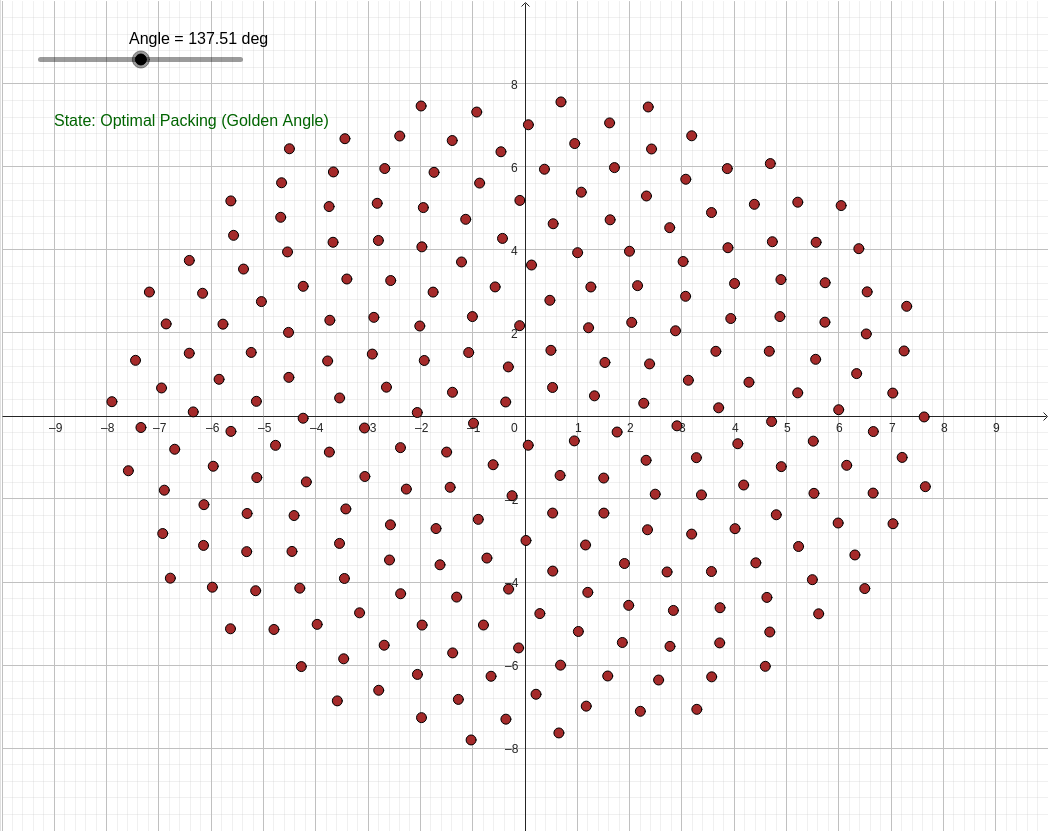
Question: Math of sunflower spirals
The mesmerizing patterns found in the head of a sunflower are a classic example of phyllotaxis, the arrangement of leaves or seeds on a plant stem. The goal for the plant is to pack the maximum number of seeds into a circular area without leaving large gaps or wasting space.
1. The Fermat Spiral
The seeds follow a mathematical curve known as Fermat's Spiral. The position of the
-th seed is determined by two coordinates:
- Distance ( ): The distance from the center grows with the square root of the seed number ( ). This ensures that as we move outward, the area available to each seed remains roughly constant.
- Angle ( ): Each new seed is placed at a specific "Divergence Angle" relative to the previous one.
2. The Golden Angle
The efficiency of the packing depends entirely on the angle chosen. If the angle is a simple fraction of a full circle (like
or
), the seeds would form straight lines radiating from the center, leaving massive empty wedges.
To avoid this, nature uses the Golden Angle, approximately
. This angle is derived from the Golden Ratio (
):
Because the Golden Ratio is the "most irrational" number, it ensures that no seed ever perfectly aligns with a previous one. This creates the most compact possible packing.
3. Fibonacci Spirals
In the diagram, you will notice two sets of spirals curving in opposite directions (clockwise and counter-clockwise). If you count these spirals, you will find that the number of clockwise spirals and the number of counter-clockwise spirals are almost always two consecutive numbers in the Fibonacci sequence (e.g., 21 and 34, or 34 and 55).
Visualizing the Efficiency
The interactive diagram allows you to adjust the Divergence Angle.
- At (The Golden Angle): You will see a perfect, gapless distribution of "seeds" (the brown dots).
- Small Deviations: Even a tiny change (e.g., to or ) causes the pattern to break down into visible "arms" or "gaps," demonstrating why the Golden Angle is mathematically optimal for survival.
Instructions: Move the slider to change the angle and observe how the spirals appear, disappear, and align.