Melting a Sphere into Cones: Volume and Similar Solids
Grades 10-11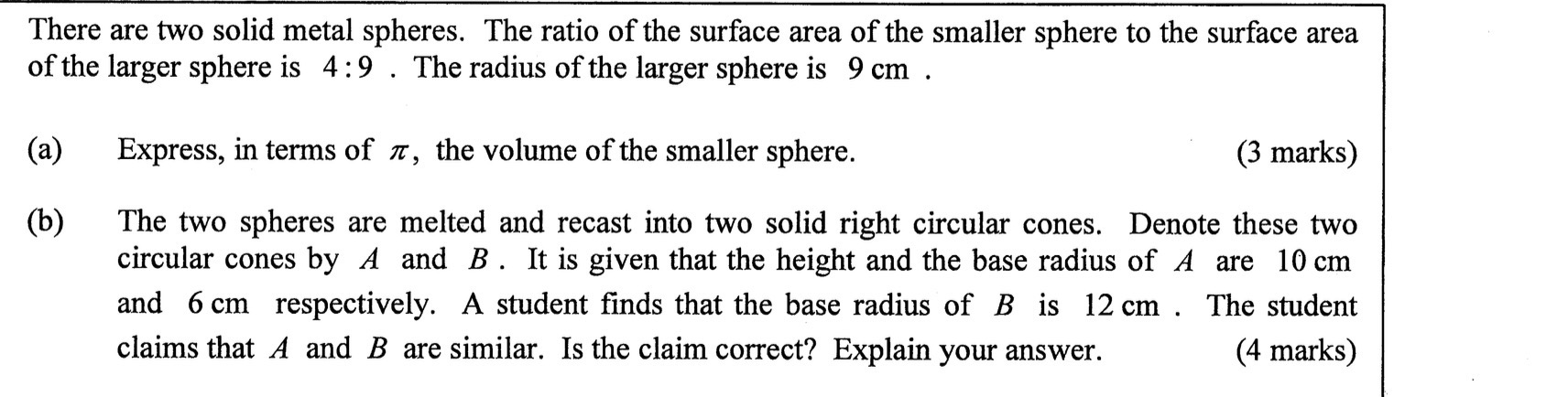
Question: Give me the graph
To solve this problem, we first determine the dimensions of the spheres using the properties of similar solids, then apply the principle of conservation of volume to analyze the resulting cones.
(a) Volume of the Smaller Sphere
For any two similar solids, the ratio of their surface areas is equal to the square of the ratio of their linear dimensions (such as radii). Let
be the radius of the smaller sphere and
be the radius of the larger sphere.
Now, we calculate the volume of the smaller sphere using the formula
:
(b) Similarity of Cones A and B
First, we find the total volume of the metal available from both spheres:
Next, we calculate the volume of Cone
(
):
Since the total metal is recast into Cones
and
, the volume of Cone
is:
Given the base radius of Cone
is
cm (
), we find its height
:
To check if the cones are similar, the ratio of their radii must equal the ratio of their heights:
Since
, the ratios are not equal. Therefore, the claim is incorrect; Cones
and
are not similar.
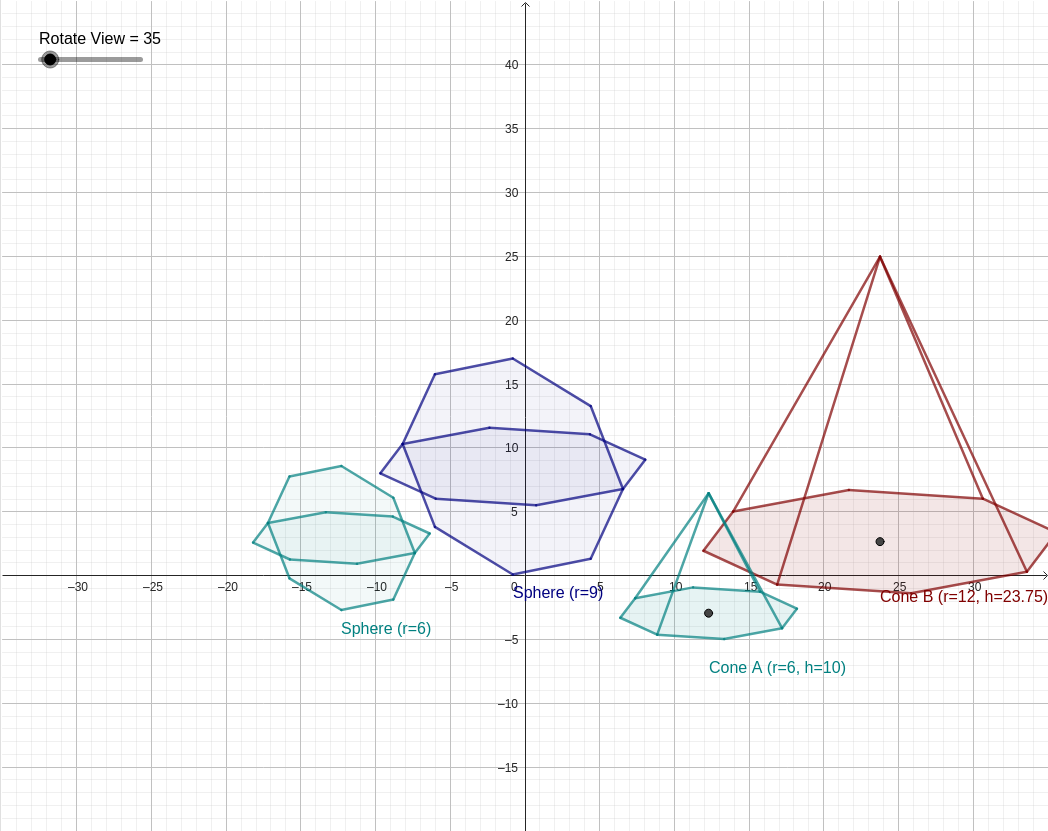
Visual Guide
The diagram illustrates the "Before and After" state of the metal.
- On the left, you can see the two spheres. The smaller sphere (teal) has a radius of cm, while the larger sphere (navy) has a radius of cm.
- On the right, the recast cones are shown. Cone A (teal) maintains a radius of cm but has a height of cm. Cone B (maroon) has a larger radius of cm and a calculated height of cm.
- Note that while Cone B is wider and taller, its proportions are different from Cone A, which is why they are not similar solids.