y = sin 5x vs y = sin 2x: How Frequency Changes a Sine Graph
Grades 9-10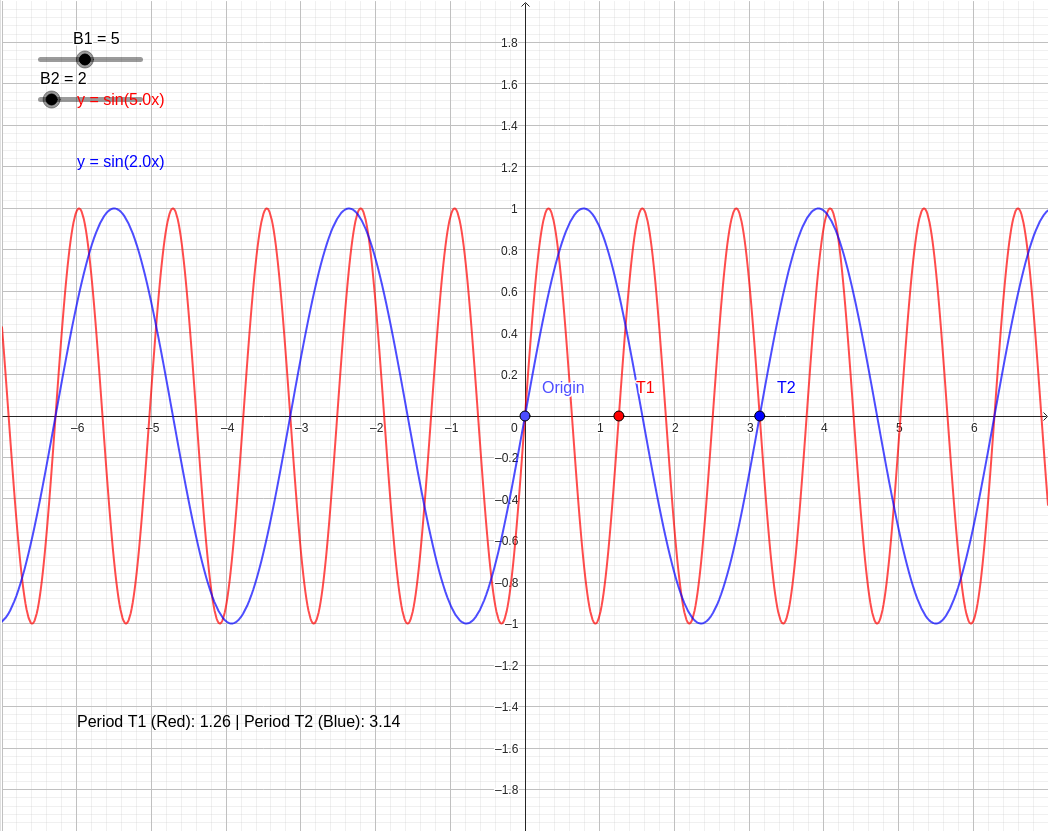
Question: y = sin(5x) y = sin(2x)
To understand the behavior of the trigonometric functions
and
, we must look at the standard form of a sine wave:
.
1. The Role of the Coefficient
The value
inside the sine function is the angular frequency. It controls how "stretched" or "compressed" the wave is horizontally.
- Period ( ): This is the distance required for the function to complete one full cycle (from to in the standard case). The formula for the period is:
- Frequency: A higher value of results in a shorter period, meaning the wave oscillates more frequently within the same interval.
2. Comparing the Two Functions
- For (Blue Curve): The period is . In a span of units, this function will complete exactly two full cycles.
- For (Red Curve): The period is . In a span of units, this function will complete exactly five full cycles.
3. Visual Observations
When plotted together, you will notice:
- Compression: The red curve ( ) appears much "tighter" or more compressed than the blue curve ( ).
- Intersections: Both curves start at the origin . They intersect whenever or .
- Amplitude: Notice that both functions have an amplitude of . The coefficient affects the horizontal scale (period) but does not change the vertical height (amplitude) of the peaks and valleys.
The following interactive diagram allows you to see how the number of cycles changes as you adjust the coefficients
and
.