Shading Feasible Region for a System of Inequalities
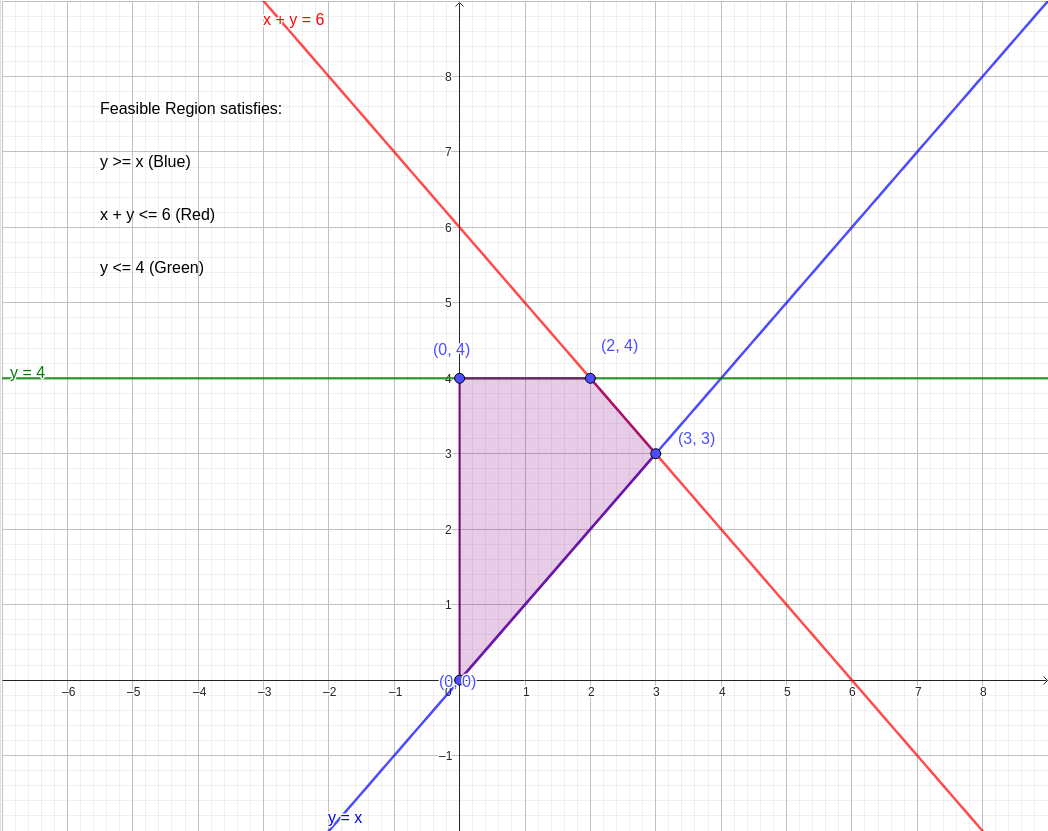
Question: Shade the feasible region satisfying the system of inequalities: y ≥ x, x + y ≤ 6, and y ≤ 4
To find and shade the feasible region satisfying the given system of inequalities, we must first determine the boundary lines and then identify the region that satisfies all conditions simultaneously.
1. Identify the Boundary Lines
Each inequality corresponds to a boundary line where the inequality becomes an equality:
- Blue Line (
):
- This is a diagonal line passing through the origin , , , etc.
- Red Line (
):
(or
)
- This line has a -intercept of and an -intercept of . It passes through , , and .
- Green Line (
):
- This is a horizontal line where every point has a -coordinate of .
2. Determine the Shaded Direction
For each inequality, we determine which side of the line to shade:
- : We shade the region above (or to the left of) the line .
- : We shade the region below the line .
- : We shade the region below the horizontal line .
3. Locate Key Intersection Points
The vertices of the feasible region are found where these boundary lines intersect:
- Intersection of and : Setting gives , so . Since , the point is .
- Intersection of and : Setting in gives , so . The point is .
- Intersection of and : Setting in gives . The point is . (Note: This point lies on the lines, but we must check if it satisfies . Since , which is not , this specific vertex is not part of the final region's boundary).
4. The Feasible Region
By testing a point such as
:
- (Satisfies )
- (Satisfies )
- (Satisfies )
Since
satisfies all three inequalities, the feasible region is the area containing this point. If we assume the standard non-negativity constraints (
) often found in these problems, the region is a quadrilateral with vertices at
,
,
, and
. Even without those constraints, the region is the intersection of the three half-planes shown in the diagram.