Completing the Square: Vertex of y = x² + 2x + 3
Grades 9-10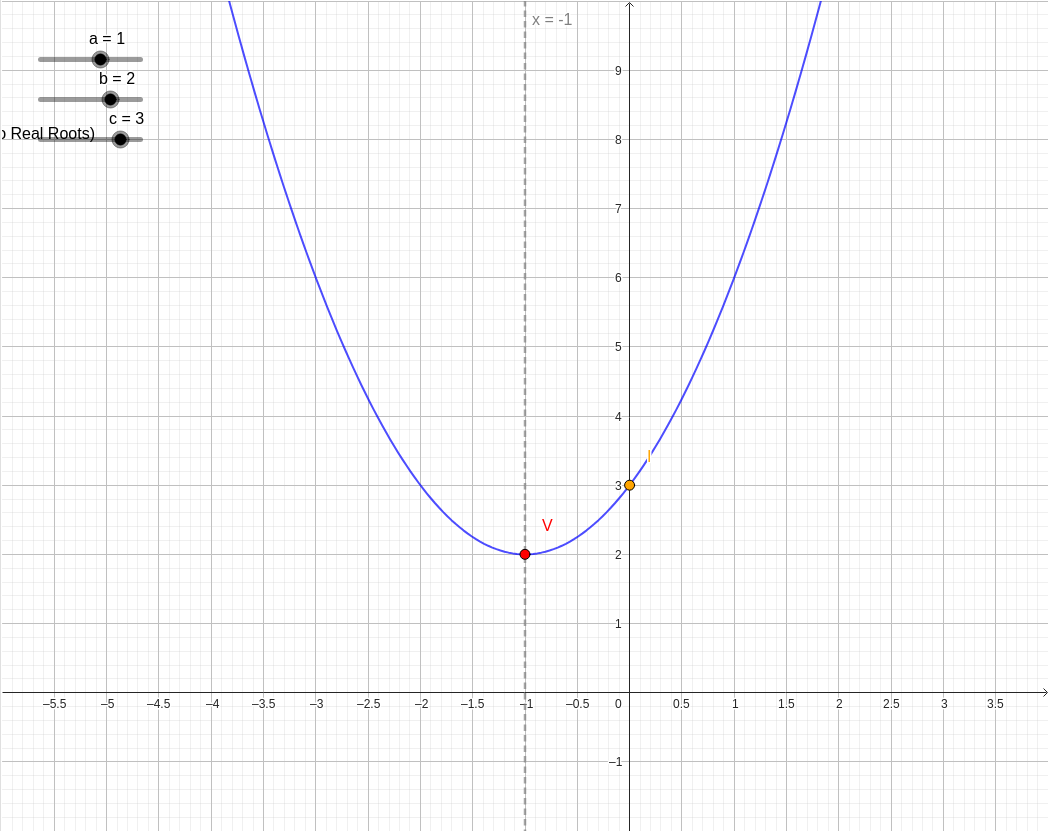
Question: x^2+2x+3
The quadratic expression
represents a parabola that opens upwards. By looking at its algebraic properties, we can determine exactly how it sits on the coordinate plane.
1. The Vertex and Completing the Square
The vertex is the "turning point" of the parabola. We can find it by converting the expression into vertex form through completing the square:
From this form,
, we identify the vertex
as
. Since the leading coefficient (
) is positive, the vertex is the absolute minimum point of the function.
2. Y-Intercept
The y-intercept occurs where
. Substituting zero into the expression:
The graph crosses the vertical axis at the point
.
3. The Discriminant and Real Roots
To see if the graph crosses the x-axis, we calculate the discriminant (
):
Because the discriminant is negative (
), the quadratic equation
has no real roots. Geometrically, this confirms that the entire parabola floats above the x-axis and never touches it.
4. Symmetry
Every parabola is symmetric. The axis of symmetry is the vertical line passing through the vertex. For this function, that line is
.
In the diagram below:
- The blue curve is the graph of .
- The red point (V) marks the vertex at .
- The orange point (I) marks the y-intercept at .
- The dashed gray line represents the axis of symmetry.
Using the sliders, you can adjust the coefficients
,
, and
to see how changing the values shifts the vertex or changes the width of the parabola.