Sine Rule in a 3D Pyramid: Finding a Base Angle
Grades 10-11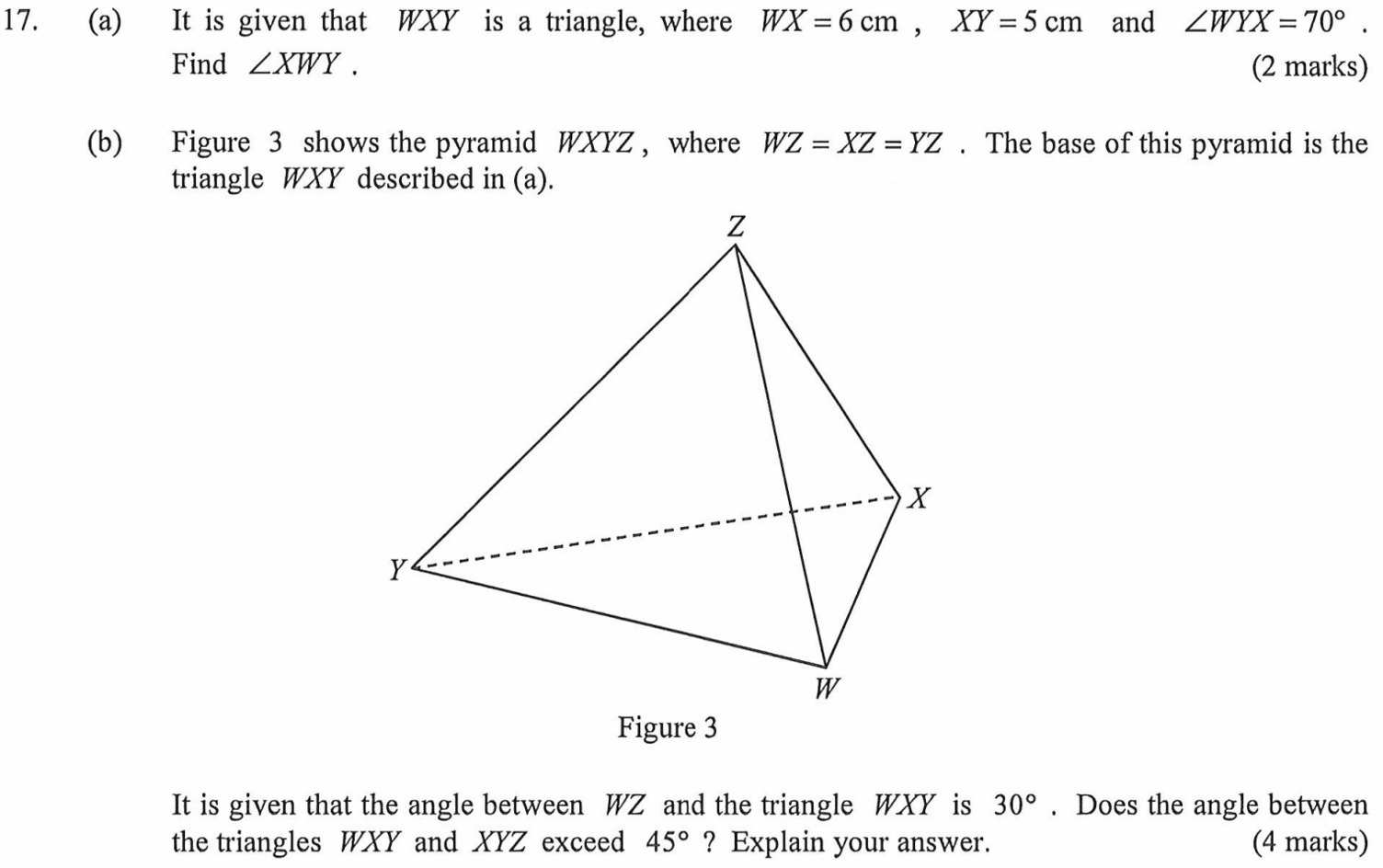
Question: Explain
To solve this problem, we apply the principles of trigonometry and 3D geometry.
Part (a): Finding
In the base triangle
, we are given the lengths of two sides (
cm and
cm) and an angle opposite one of them (
). We use the Sine Rule to find
:
Since
,
must be the largest angle opposite the longer side, which confirms that
must be acute, and there is only one valid solution.
Part (b): Finding the Angle between Triangles and
1. Locating the Projection of the Apex We are given that
. This symmetry implies that the apex
is equidistant from all three vertices of the base triangle. Geometrically, the projection of
onto the plane
is the circumcenter of triangle
, which we will call point
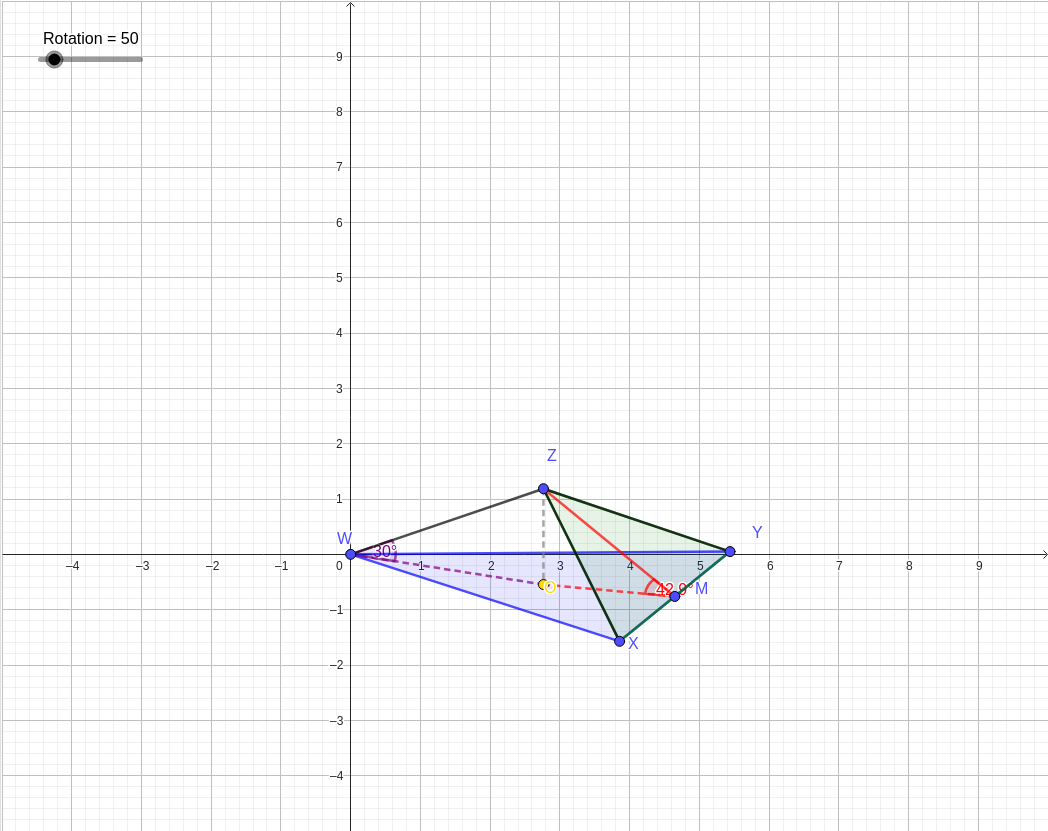
(shown in the diagram).
2. Calculating the Height of the Pyramid In the right-angled triangle
, the angle
is the angle between the line
and the base plane, which is given as
. Let
be the circumradius
:
The height of the pyramid
is:
3. Determining the Dihedral Angle The angle between the triangles
and
is the dihedral angle along their common edge
. Let
be the midpoint of
. Since
, triangle
is isosceles, meaning
. Similarly, in the base,
is the circumcenter, so the segment
is the perpendicular bisector of
, meaning
. Thus, the dihedral angle is
.
In right
:
In right
:
Calculating the angle:
Since
, the angle between the triangles does not exceed
.
Visualization
In the interactive diagram below:
- The blue base represents triangle .
- Point O (gold) is the circumcenter where the apex projects onto the base.
- The 30° angle at (purple) represents the inclination of the edge .
- The angle at M (red) represents the dihedral angle between the base and the back face .
- Use the Rotation slider to view the pyramid from different perspectives.