3D Pyramid Trigonometry Problem, Solved Step by Step
Grades 10-11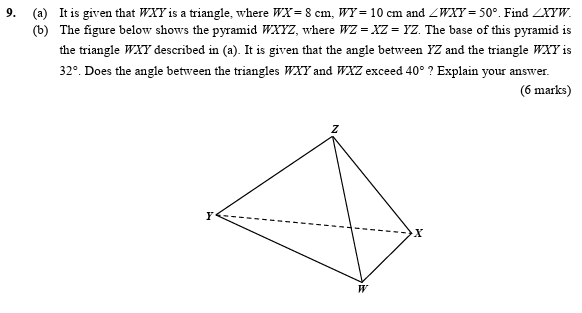
Question: analyze this image and solve it step by step, no need slider, avoid overlapping of labels / collisions, zoom closer
To solve this geometry problem, we will first use the Sine Rule for the base triangle and then apply 3D trigonometry to analyze the pyramid.
Part (a): Finding
In triangle
, we are given two sides and an opposite angle. Using the Sine Rule:
Substituting the known values (
cm,
cm, and
):
Part (b): Analyzing the Pyramid
1. Finding the Apex Position
The problem states that
. This geometric property implies that the vertex
is equidistant from all vertices of the base triangle. Consequently, the projection of
onto the base plane
is the circumcenter of triangle
. Let this point be
. The distance from
to any vertex (
) is the circumradius
.
Using the Sine Rule again:
2. Calculating the Height
The angle between the edge
and the base
is given as
. In the right-angled triangle
:
3. Finding the Angle between Triangles
and
The angle between these two triangles is the dihedral angle at the edge
. Let
be the midpoint of
. Since
, triangle
is isosceles, making
perpendicular to
. Similarly, since
is the circumcenter,
is the perpendicular bisector of
. The angle we seek is
in the right-angled triangle
. First, calculate
:
Now, find the angle
:
Since
does not exceed
, the answer is No.
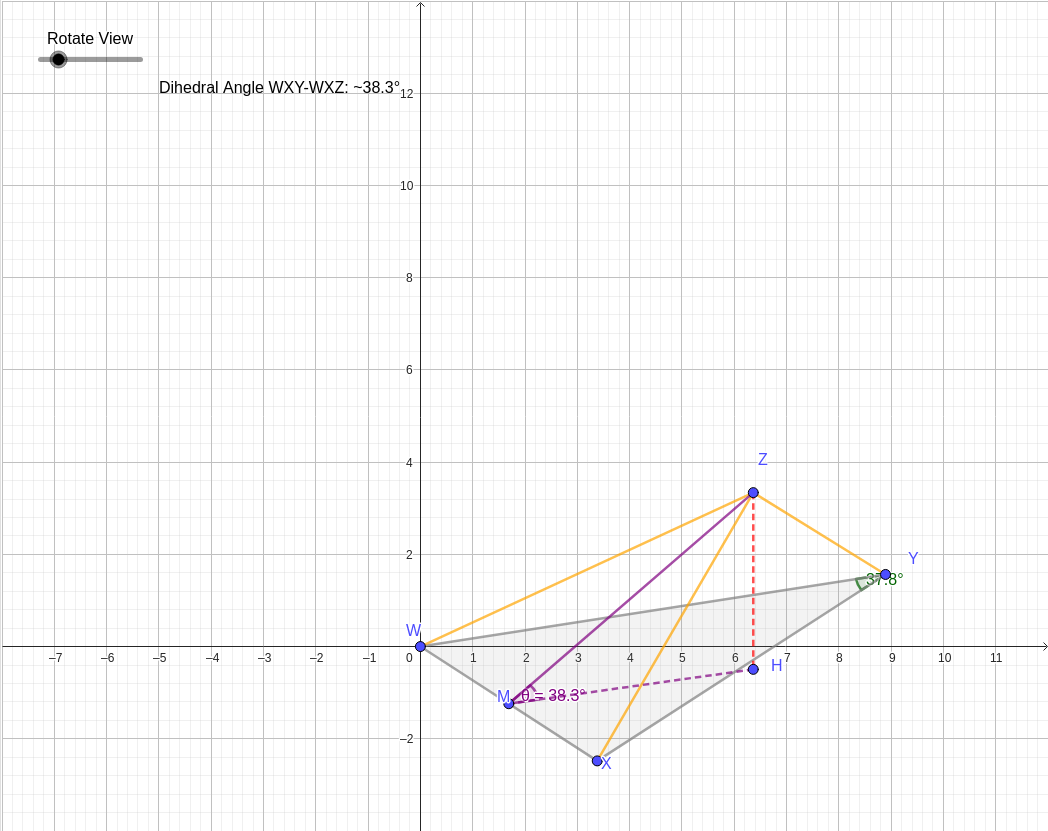
The diagram below visualizes the pyramid, showing the base triangle
in grey, the height
in red, and the dihedral angle
that determines the slant of face
.