Curved Surface Area of a Cylinder (2πrh) Explained
Grades 8-9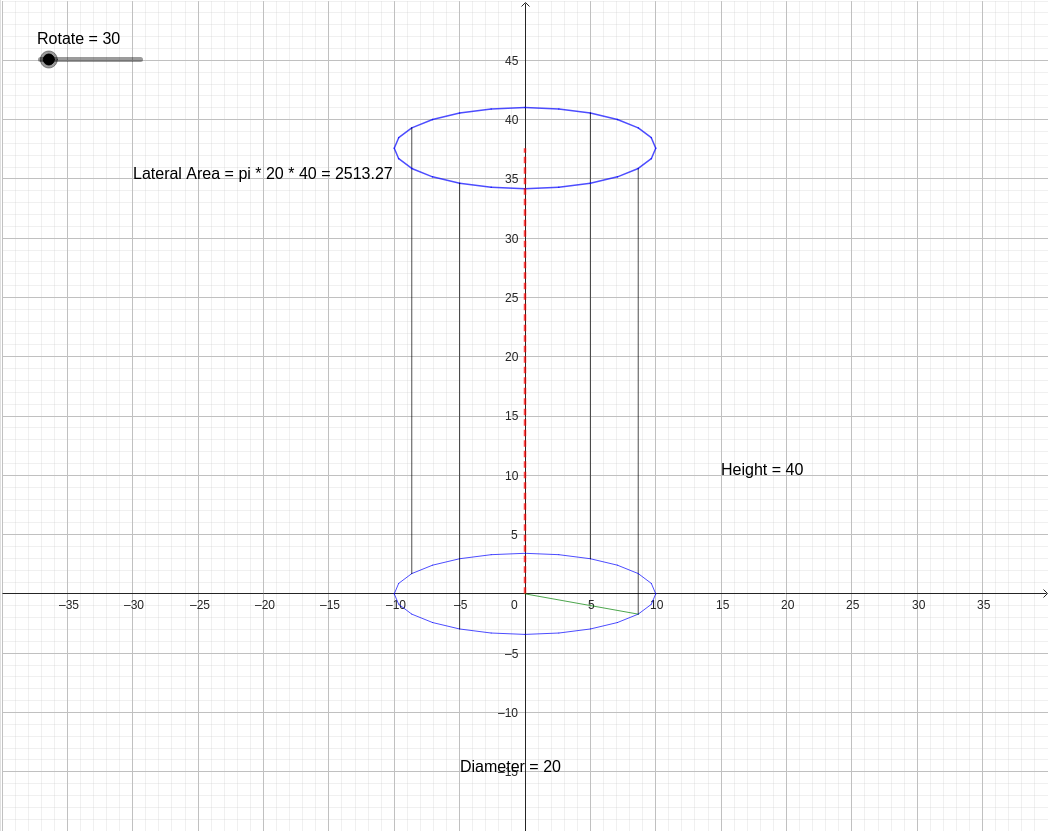
Question: pi x 20 x 40
The expression
represents a geometric calculation typically associated with the lateral surface area of a cylinder.
To understand this visually, imagine a cylinder with a diameter of
units and a height of
units. The calculation can be broken down into two parts:
- The Circumference ( ): The value represents the distance around the circular base of the cylinder. If you were to "cut" the cylinder vertically and roll it out flat, this circumference would become the width of a rectangle.
- The Height ( ): This is the vertical length of the cylinder. In our "unrolled" rectangle, this becomes the length.
Calculation Breakdown
The area
of the curved surface is found by multiplying the perimeter of the base by the height:
In the interactive diagram below:
- The blue circle represents the base of the cylinder with a diameter of (radius of ).
- The vertical segment represents the height of .
- The gray shaded region represents the lateral surface whose area is exactly .
- You can use the Rotation slider to view the cylinder from different perspectives.