Perpendicular Lines and Locus: Coordinate Geometry Question
Grades 10-11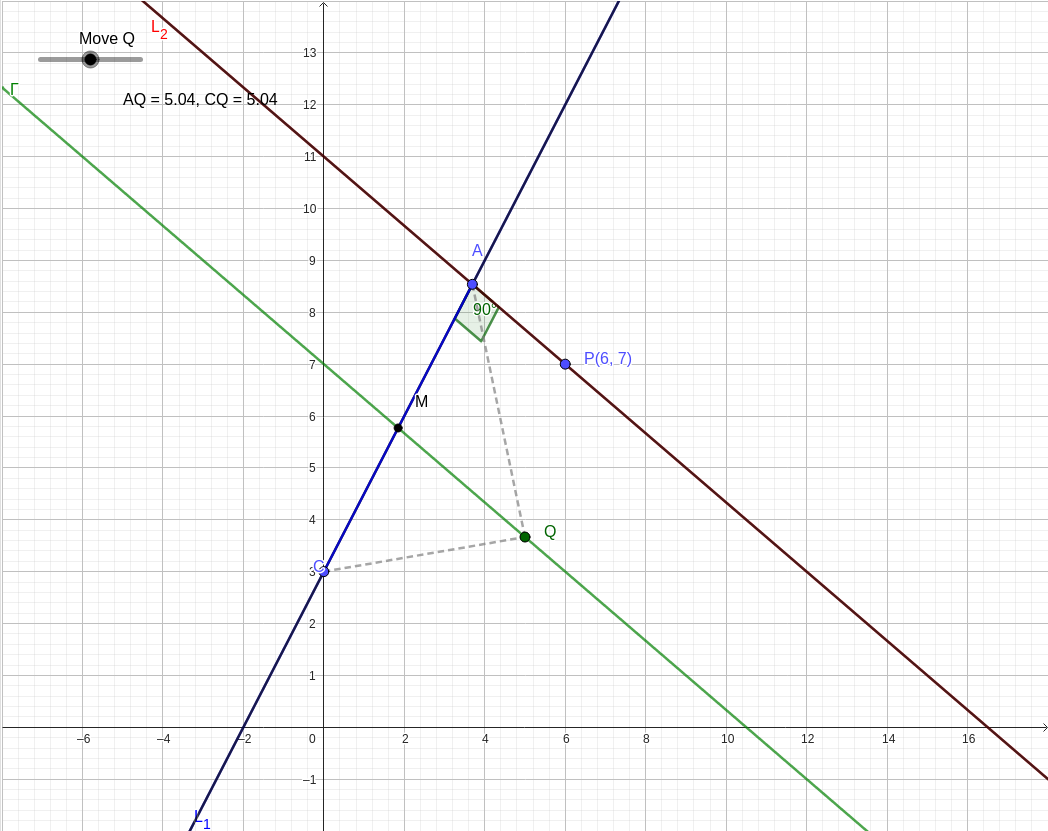
Question: In the figure, the straight line L1: 3x – 2y + 6 = 0 and the straight line L2 are perpendicular to each other and intersect at A. It is given that L1 cuts the y-axis at C and L2 passes through the point (6, 7). (a) Find the equation of L2. (3 marks) (b) Q is a moving point in the coordinate plane such that AQ = CQ. Denote the locus of Q by . (i) Describe the geometric relationship between and L2. Explain your answer. (ii) Find the equation of .
To solve this problem, we will look at the relationships between lines and points in the coordinate plane.
(a) Finding the Equation of
First, we find the slope of
. By rewriting
in the slope-intercept form
:
The slope of
is
.
Since
and
are perpendicular, the product of their slopes is
. Let
be the slope of
:
passes through the point
. Using the point-slope form:
(b) The Locus
(i) Geometric Relationship between and
The moving point
satisfies
. In geometry, the locus of points equidistant from two fixed points
and
is the perpendicular bisector of the segment connecting those points.
- Points and both lie on line (since is the y-intercept of and is the intersection of and ).
- Therefore, is the perpendicular bisector of the segment which lies on .
- Since and we are given , both lines are perpendicular to the same line.
- Thus, is parallel to .
(ii) Finding the Equation of
First, we find the coordinates of
and
:
- For (y-intercept of ): set in . So .
- For (intersection of and ): Solve and . Solving this system gives .
The midpoint
of
is:
has the same slope as
, which is
, and passes through
:
Multiplying by
:
Dividing the equation by 13:
The provided diagram visualizes
(blue) and
(red) intersecting at
. The locus
(green) is shown as the perpendicular bisector of the segment
, remaining parallel to
.