Parabolic Trajectory: Launch Angle, Vertex and Range
Grades 10-11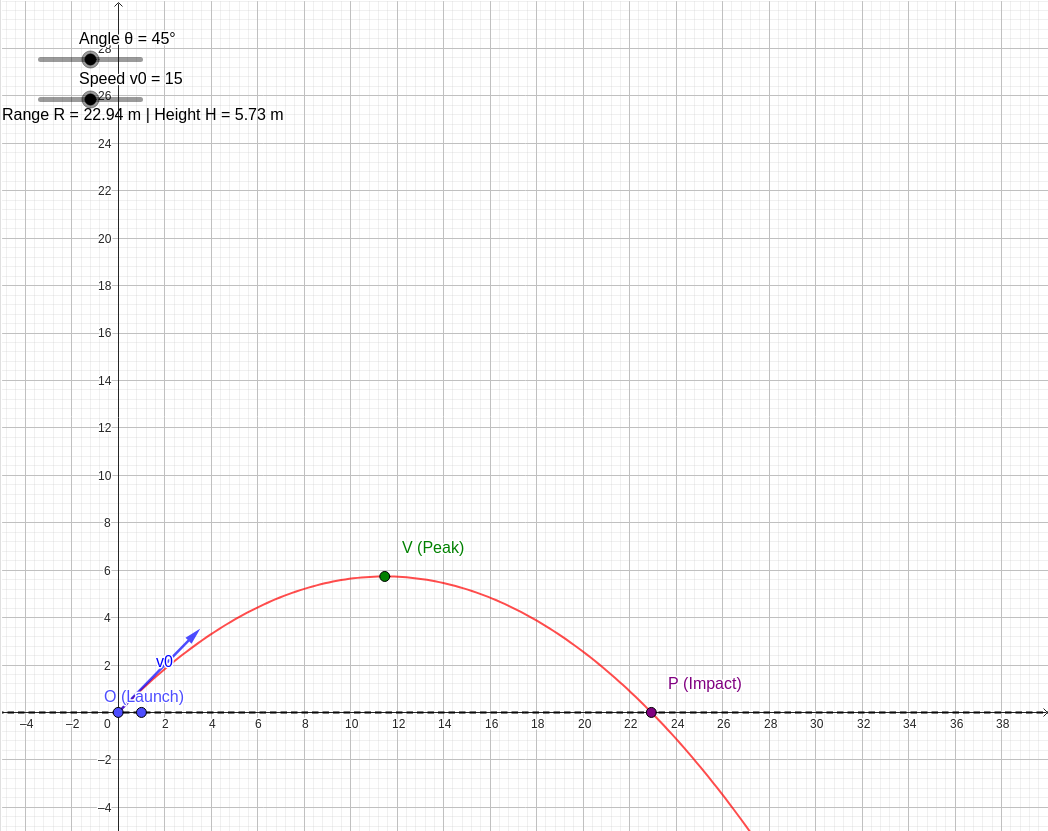
Question: Parabolic trajectory
Parabolic trajectory is a classic topic where physics and geometry meet. When an object is launched and affected only by gravity (ignoring air resistance), its path of motion is mathematically a two-dimensional parabola.
We usually break this motion into two independent components:
-
Horizontal motion: since no force acts horizontally, the object moves at constant velocity.
-
Vertical motion: under gravitational acceleration , the object undergoes uniformly accelerated motion vertically.
Eliminating the time parameter
gives us the trajectory's function:
In this model, we can identify the following key features:
- Launch angle ( ): determines the shape of the trajectory. On level ground, a angle theoretically gives the maximum range.
- Vertex: the maximum height the object reaches, where its vertical velocity is zero.
- Range: the horizontal distance traveled when the object returns to its launch height.
- Symmetry: ignoring air resistance, the rising and falling paths are perfectly symmetric.
In the interactive graph below:
- Red curve: the object's actual flight path.
- Blue vector: the direction of the initial launch velocity.
- Green point (V): the highest point of the trajectory (the vertex).
- Purple point (P): the landing point, i.e. where the range ends.
- Adjust the sliders to see how the initial speed and launch angle dynamically affect the width and height of the whole parabola.