Proving Inequalities: Squares, Surds and Telescoping Sums
Grades 10-11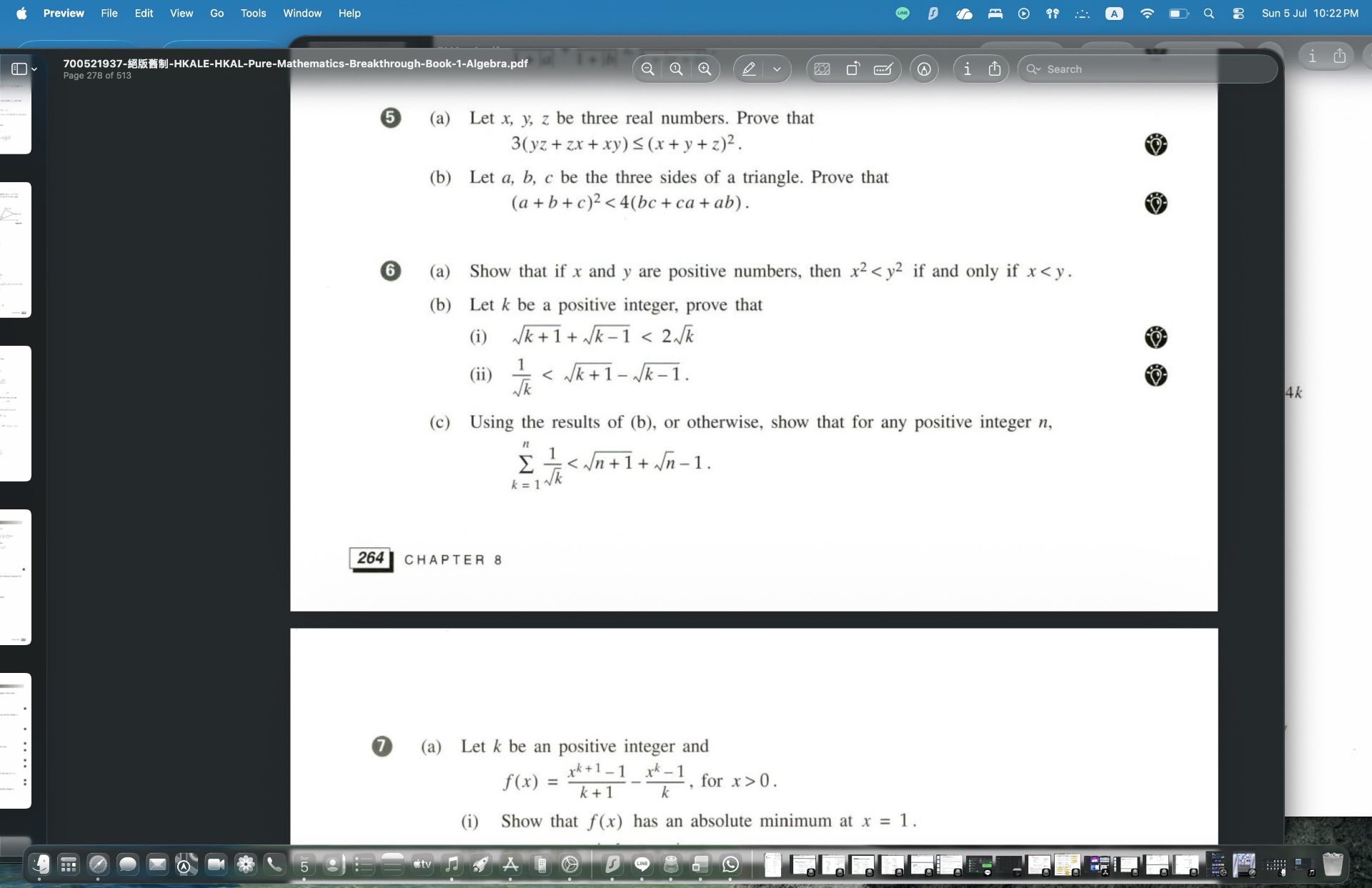
Question: Q6
To solve Question 6, we apply properties of quadratic functions, algebraic manipulation of square roots (rationalization), and the concept of telescoping sums.
Part (a): Squares and Positive Numbers
For any two real numbers
and
, we can factor the difference of their squares:
If
and
are positive, then their sum
must be strictly greater than zero. Consequently, the sign of the expression
is entirely determined by the sign of
.
- If , then , so , which implies .
- If , then , so . Since , it follows that , meaning .
This result is fundamental because it allows us to square both sides of an inequality (or take the square root) involving positive numbers without changing the direction of the inequality.
Part (b): Square Root Inequalities
(i) Proving
Since both sides are positive, we can square them using the result from part (a):
The square of the right-hand side is
. Comparing the two, since
for any positive integer
, we know
. Thus,
. Taking the square root of both sides proves the inequality.
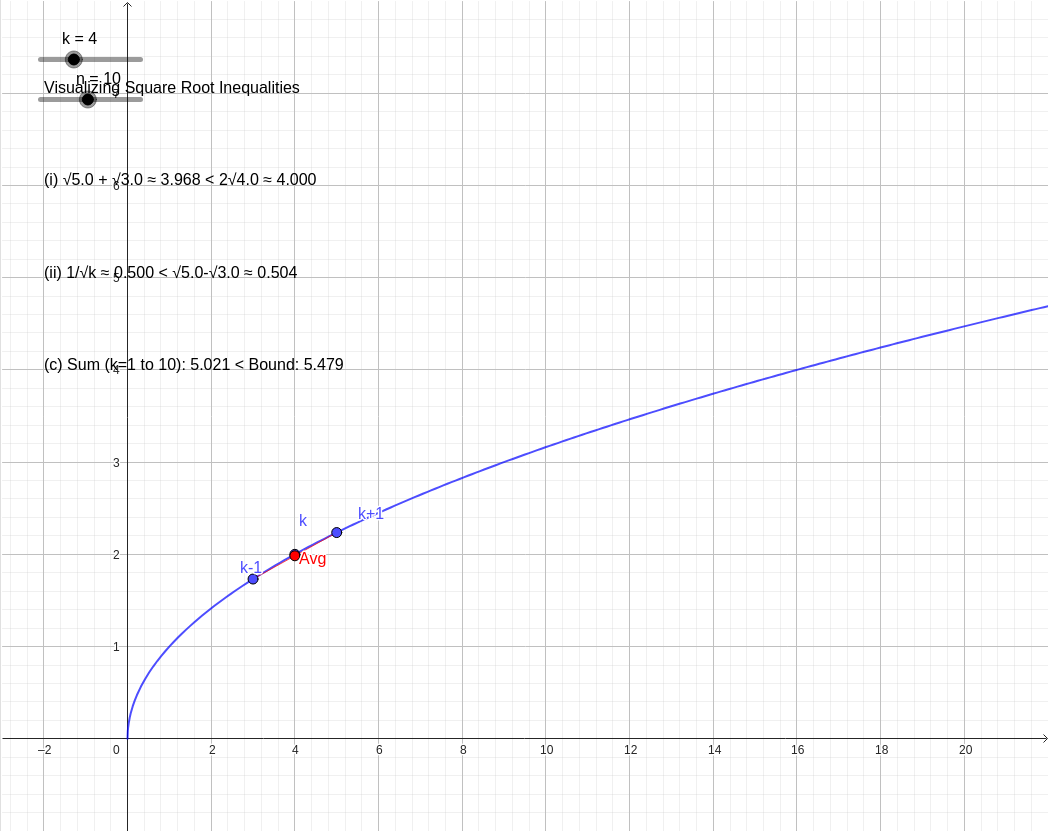
Geometric Intuition: This inequality arises because the function
is concave. In the diagram, the blue curve representing
always stays above any chord (the red segment) connecting two points on the curve. The midpoint of the chord represents the average height
, which is visually lower than the curve height
at the midpoint
.
(ii) Proving
Starting from the result in (i):
Since
is positive, we multiply both sides by it:
Dividing by
:
Part (c): The Telescoping Sum
To prove
, we substitute the inequality from (b)(ii) into each term of the sum:
This is a telescoping sum. Notice how
cancels with
,
will cancel with a later term, and so on. Only the terms that do not have a pair remain:
- The negative terms at the start: and .
- The positive terms at the end: and . Thus, the sum simplifies to:
The interactive diagram allows you to change the values of
and
to see these relationships hold true numerically and geometrically.