Limits in Physics: Instantaneous Velocity Explained
Grades 11-12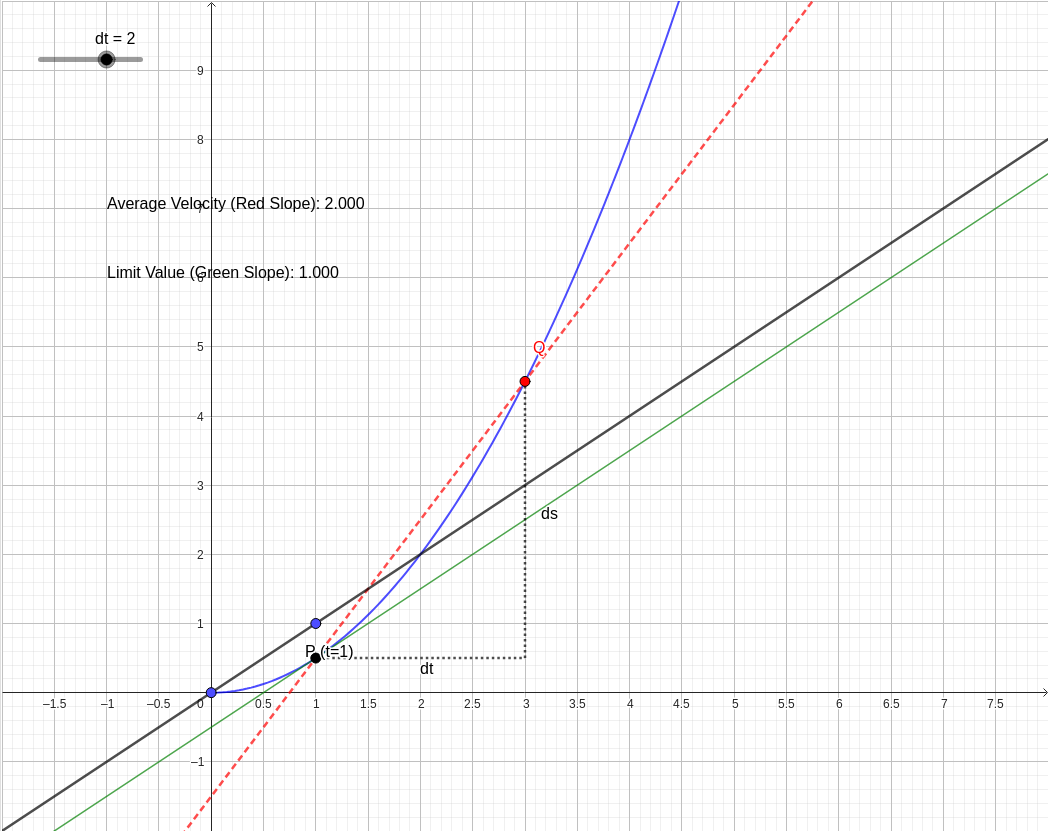
Question: What is limit function in physics
In physics, the concept of a limit is the mathematical foundation used to define change at a single, precise moment. Most physical laws describe how things change—how position changes with time (velocity), or how velocity changes with time (acceleration). However, measuring change usually requires a "before" and an "after" (an interval).
The "limit" is the bridge that allows us to shrink that interval until it is effectively zero, turning an average measurement into an instantaneous one.
1. The Problem of Zero Time
If you want to find your exact speed at exactly
seconds, you might try to use the formula for velocity:
Where
is the change in position and
is the change in time. If you look at only one instant, the change in time
is
. Mathematically,
is undefined. We cannot calculate speed "at a point" using simple division.
2. The Limit as the Solution
Instead of looking at the instant directly, we look at what happens as we make the time interval smaller and smaller. This is written as:
This expression says: "Calculate the average speed over a tiny window of time, and see what value that average approaches as the window shrinks toward zero." That resulting value is the instantaneous velocity—the derivative of position with respect to time.
3. Visualizing the Limit
In the diagram below:
- The blue curve represents the position of an object over time.
- The red line (the secant) shows the average velocity between two points and . Its slope is the average speed.
- The green line (the tangent) shows the instantaneous velocity at point .
- By moving the slider, you reduce the time interval . Notice how the red line "limits" toward the green line. As the gap between and vanishes, the average speed becomes the instantaneous speed.
This principle is used everywhere in physics:
- Newton's Second Law: Force is the limit of momentum change over time ( ).
- Electric Current: Current is the limit of charge flow over time ( ).
- Thermodynamics: Pressure and temperature are often defined as limits of molecular behavior in large systems.
Moving the slider for
demonstrates how the "Limit" function physically converges onto the true value of a physical property at a specific moment.