Area Between y = e^(−x) ln(x + 3) and y = e^(−x)
Grades 11-12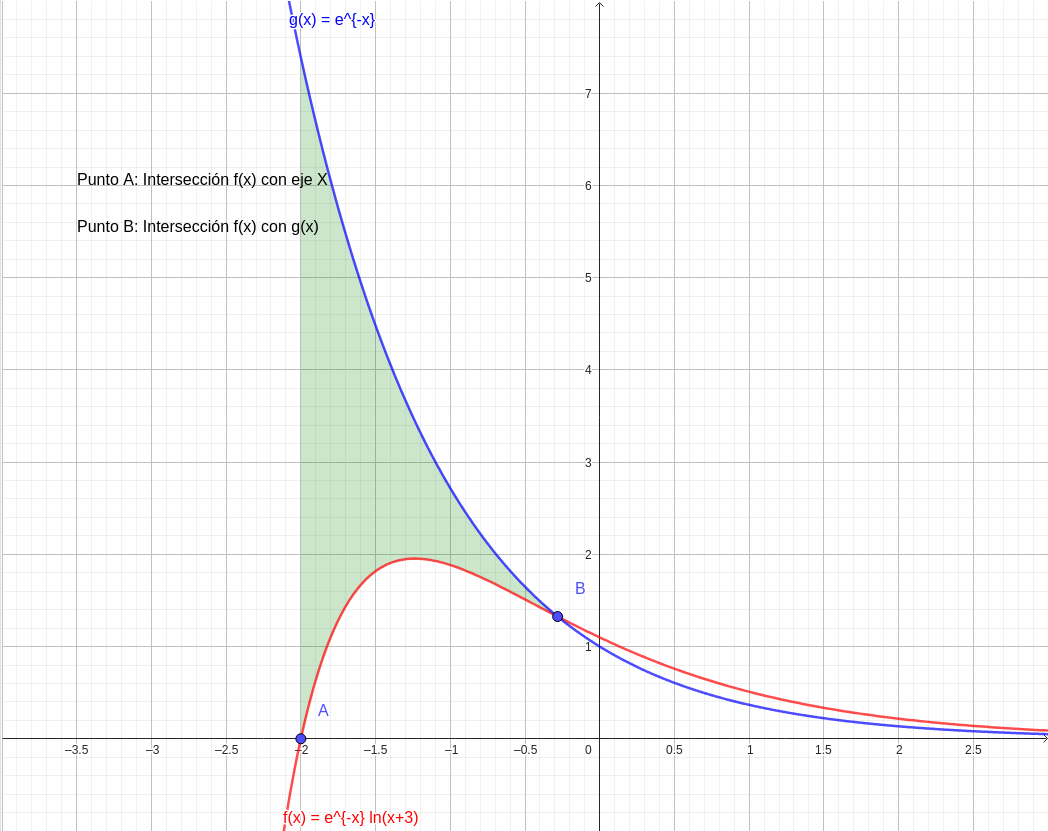
Question: y = e^(-x) ln(x+3), y = e^(-x). Give me the intersection points A and B and shade the area.
To find the intersection points and the area enclosed between the functions
and
, we follow an algebraic process and then visualize how the curves behave.
1. Finding the Intersection Points
We set both functions equal to find the
-values where they cross:
Since the exponential
is never zero for any real
, we can divide both sides by
:
To solve for
, we exponentiate both sides with base
:
Using
, we get:
Substituting this value into either original function gives the
-coordinate:
This is Point B, where the two curves meet:
.
2. The Second Reference Point (Point A)
Since the functions only intersect at one point, the "enclosed" area is defined using the axis crossings or natural boundaries of the function. The function
crosses the
-axis when
, i.e., when
, giving
.
This defines Point A:
, the starting point of the shaded region on the horizontal axis.
3. Interpreting the Area
The region of interest lies between the two curves, from the axis crossing (
) to their intersection point (
).
- Upper curve (blue): . Over this interval, this function always stays above the other one.
- Lower curve (red): . It starts at zero at point A and rises until it meets the other curve at point B.
The visualization shows how the logarithm-modulated exponential function grows from the
-axis until it "catches up" to the plain exponential, enclosing a finite area.