Integral of x⁵ ln(x + 1) from 0 to 2
Grades 11-12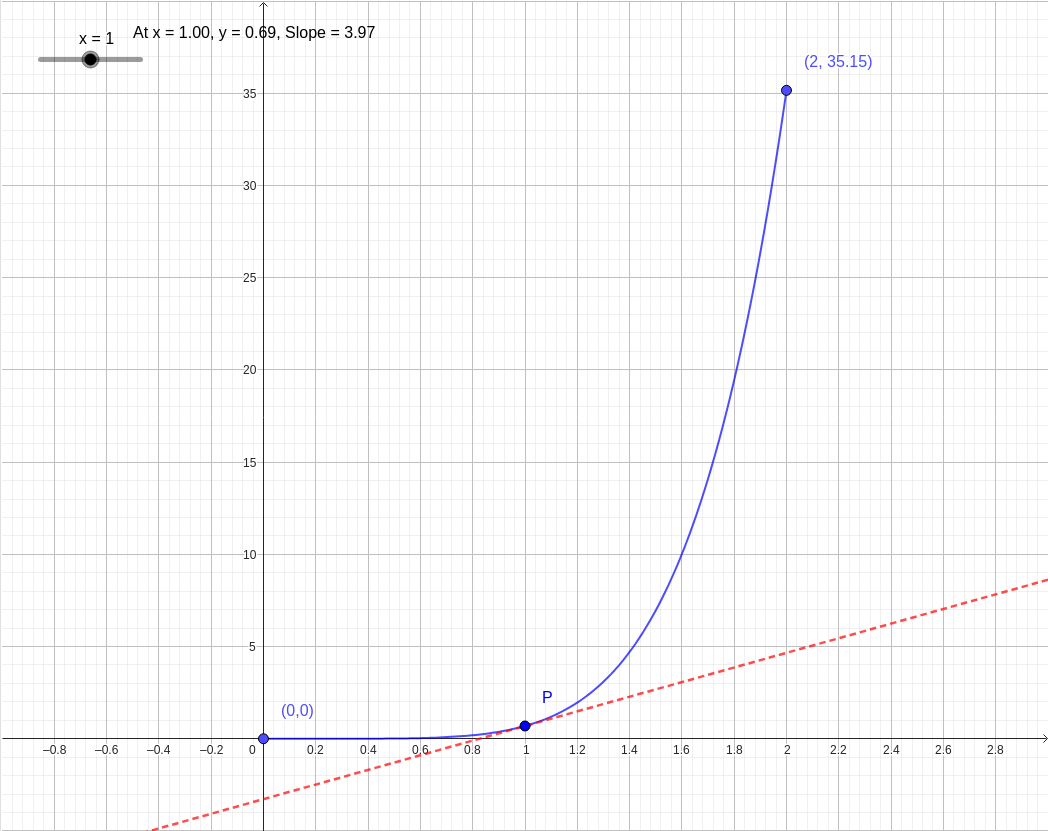
Question: 27. y = x^5 ln(x + 1), 0 ≤ x ≤ 2
The function
is a product of two distinct types of functions: a high-degree polynomial (
) and a logarithmic function (
). In the interval
, we can observe several interesting mathematical properties:
1. Behavior at the Origin
At
, the function evaluates to
. Because of the
factor, the graph is extremely "flat" near the origin. The first four derivatives of
are all zero at
, which means the curve hugs the x-axis very closely before it starts to rise.
2. Growth Rate
As
increases from 0 toward 2, the function grows very rapidly.
- The term contributes a massive scaling factor (at , ).
- The term grows much more slowly (at , ).
- The product results in a value of approximately at the endpoint .
3. The Derivative (Slope)
The slope of the curve is found using the product rule:
Since both
and
are positive for all
, the function is strictly increasing on the given interval.
Visual Guide
- The Curve (Blue): Represents the function . Notice how it stays near zero for a while and then shoots upward.
- Point P: You can move the slider to trace the point along the curve from to .
- Tangent Line (Red): Shows the instantaneous rate of change at any point. Notice how the tangent line becomes nearly vertical as approaches 2, reflecting the extremely high slope ( ).
- Bounding Box: The graph is focused on the domain and the corresponding range .