Graph of y = x⁴/(x + 1) Compared with y = x²
Grades 10-11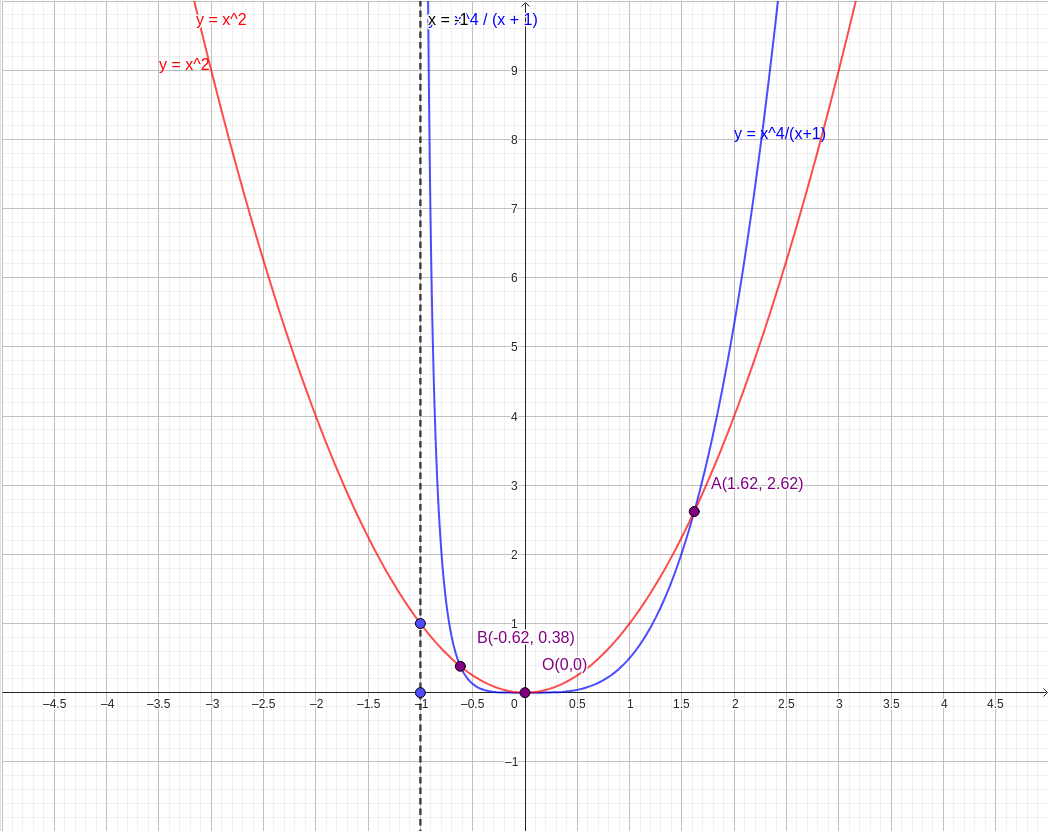
Question: y=x^4/(x+1) y=x^2
To find the intersection points of the two curves
and
, we must solve for the values of
where the functions are equal.
1. Algebraic Analysis
We set the two expressions for
equal to each other:
Factoring out the common
term:
This gives us two cases:
- Case 1: . Substituting back into , we get . This gives the intersection point .
- Case 2: . Using the quadratic formula : These are the values of the Golden Ratio ( ) and its negative reciprocal ( ).
Calculating the corresponding
-values using
:
- For , .
- For , .
2. Graphical Features
In the diagram:
- The Blue Curve represents the rational function . It has a vertical asymptote at (indicated by the dashed line), where the denominator becomes zero.
- The Red Curve represents the standard parabola .
- The three points of intersection calculated above are marked: the origin and the two points related to the Golden Ratio. Note that for large positive values of , the blue curve grows much faster (behaving like ), while for values very close to the asymptote, it shoots toward infinity.
3. Visual Reasoning
Observe that between
and
, the blue curve lies below the red parabola. After
, the rational function grows more steeply than the quadratic, which is expected since the degree of the numerator is higher.