Graph Translation: Equation of y = f(x) Moved Left and Down
Grades 9-10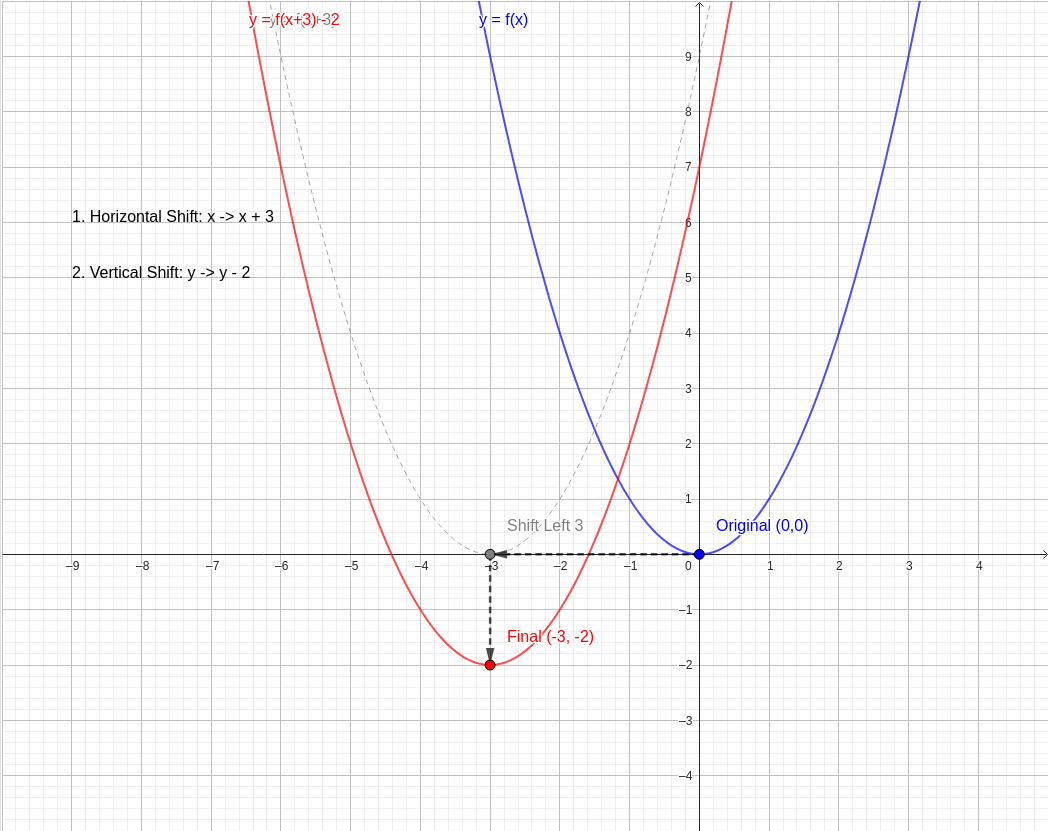
Question: The graph of y = f(x) is translated left by 3 units and down by 2 units. Write down the equation of the new graph
In the HKDSE Compulsory Part syllabus, the transformation of graphs is a key topic. When a graph
undergoes a translation, we modify the equation based on whether the movement is horizontal or vertical.
Conceptual Explanation
-
Horizontal Translation (Left/Right): This transformation affects the input of the function ( ).
- To translate the graph left by units, we replace with .
- To translate the graph right by units, we replace with .
- Reasoning: If we move the graph 3 units to the left, a point that originally occurred at now occurs at . For the function to "see" the same value it used to see at , we must add 3 to the new coordinate.
-
Vertical Translation (Up/Down): This transformation affects the output of the function ( ).
- To translate the graph up by units, we add to the entire function: .
- To translate the graph down by units, we subtract from the entire function: .
Step-by-Step Solution
Let the original equation be
.
Step 1: Translate left by 3 units Replace
with
. The intermediate equation is:
Step 2: Translate down by 2 units Subtract 2 from the right-hand side of the equation. The final equation is:
Final Answer: The equation of the new graph is
.
Visual Guide
In the diagram below:
- The blue curve represents the original graph .
- The grey dashed curve shows the intermediate step after shifting 3 units to the left.
- The red curve represents the final transformed graph .
- Notice how the vertex (or any reference point) moves from to and finally to .
法(1) [Transformation of graphs]:
(2 marks)
core_