Inscribed Angle Theorem Explained
Grades 9-10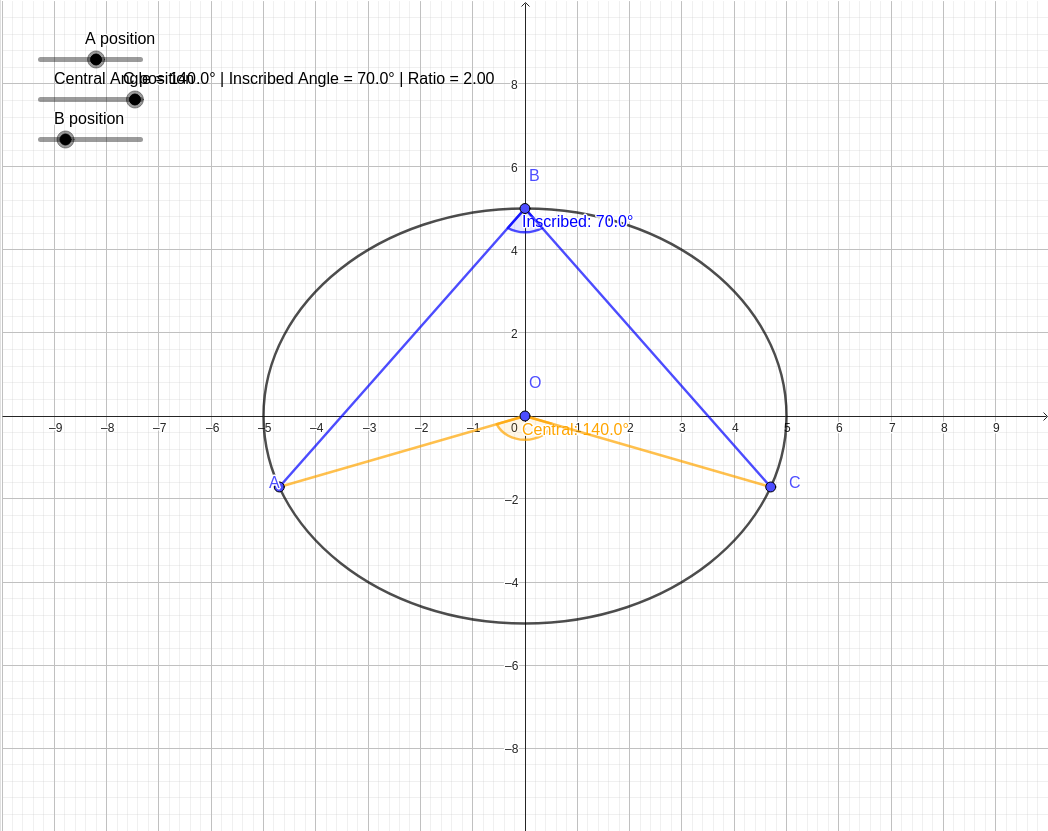
Question: .
In circle geometry, one of the most fundamental relationships is the Inscribed Angle Theorem. This theorem describes the relationship between an angle subtended at the center of a circle and an angle subtended at the circumference by the same arc.
The Theorem
For any circle with center
:
- Central Angle: The angle is formed by two radii and .
- Inscribed Angle: The angle is formed by two chords and , where is any point on the circle's circumference.
The theorem states that the central angle subtended by an arc at the center is twice the inscribed angle subtended by the same arc at any point on the circumference.
Visual Properties
In the accompanying diagram, you can observe several key properties:
- Constant Inscribed Angle: If you move point along the major arc (the larger part of the circle), the measure of remains constant. This is known as the "angles in the same segment" theorem.
- The 2:1 Ratio: The central angle (shown in orange) is always exactly double the inscribed angle (shown in blue), provided remains on the same side of the chord .
- Semicircle Case: If the chord happens to be a diameter (passing through ), then , which implies that . This special case is known as Thales' Theorem.
Geometric Proof Sketch
The theorem can be proven by dividing the inscribed angle into two parts using a line from
through the center
. This creates two isosceles triangles (
and
) because the segments
and
are all radii. Using the property that the exterior angle of a triangle is equal to the sum of the two opposite interior angles:
This simple yet powerful relationship is a cornerstone of circle geometry and is used extensively in solving complex geometric proofs and trigonometric problems.