Internal and External Angle Bisectors of a Triangle
Grades 9-10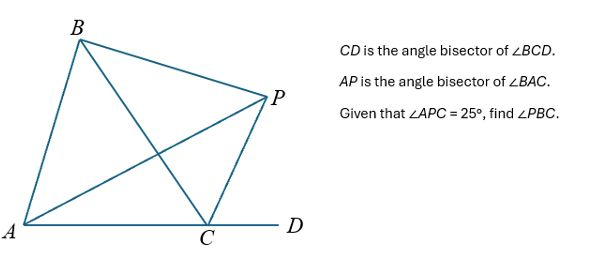
Question: solve
To find the value of
, we can use the properties of internal and external angle bisectors in a triangle.
1. Identifying the Geometry
In the given diagram, we are looking at
:
- is the internal angle bisector of . This means .
- The line is extended to , making an exterior angle of the triangle at vertex .
- The text states " is the angle bisector of ," which is likely a typo for (the ray shown in the diagram). We assume is the external angle bisector of . This means .
2. Finding the value of
There is a known geometric theorem stating that the angle formed by the intersection of an internal bisector of one angle and the external bisector of another angle in a triangle is equal to half of the third internal angle.
Mathematically, for
:
Given that
:
3. Finding the value of
The point
is the intersection of an internal bisector (
) and an external bisector (
). In geometry, this point is called an excenter of the triangle. Specifically, since it lies on the internal bisector of
and the external bisector of
, it is the excenter opposite to vertex
.
A property of an excenter is that the line connecting the third vertex (
) to the excenter (
) must also be an angle bisector. Since
is the excenter opposite
, the line
must be the external angle bisector of
.
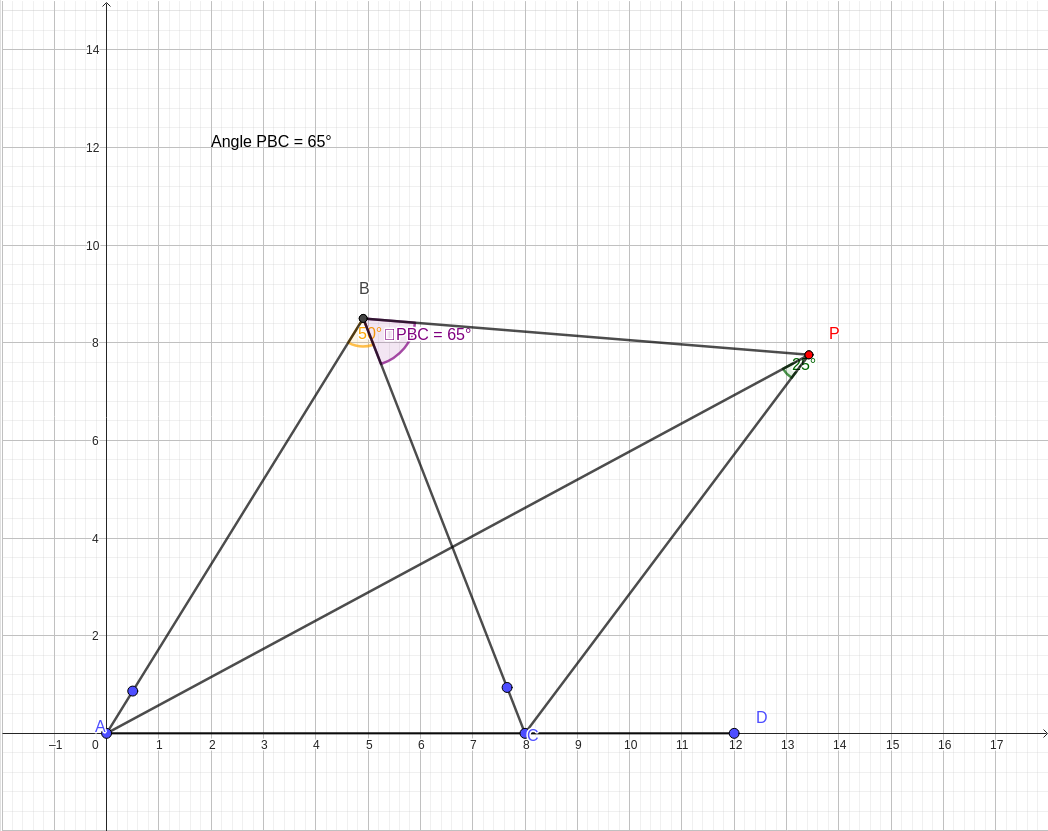
- First, we find the exterior angle at vertex :
- Since bisects this exterior angle, is half of :
Therefore, the value of
is
.