Angle at the Centre Is Twice the Angle at the Circumference
Grades 9-10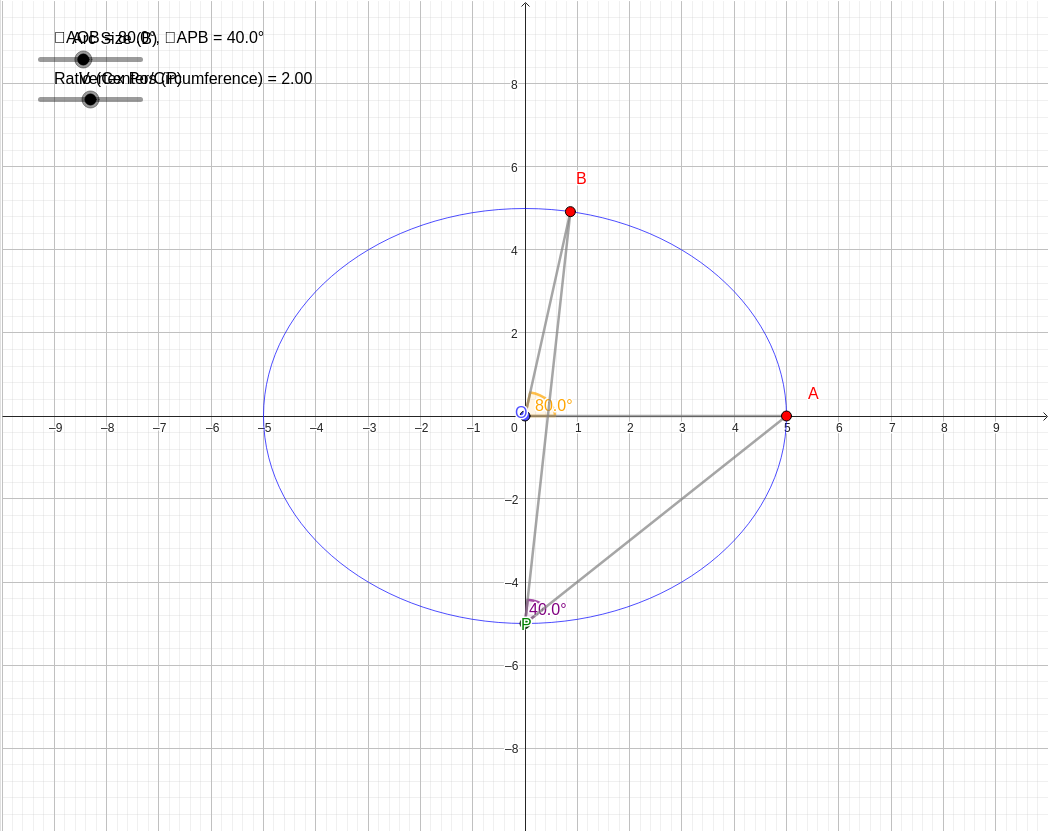
Question: .
The Angle at the Center Theorem is a fundamental principle in circle geometry. It states that the angle subtended by an arc at the center of a circle is twice the angle subtended by the same arc at any point on the remaining part of the circumference.
Geometric Components
In the accompanying diagram, you can explore this relationship dynamically:
- The Circle (Blue): A circle centered at point .
- The Arc (AB): Defined by point (fixed) and point (adjustable). The arc is the part of the circumference between these two points.
- Central Angle (Orange): The angle formed at the center of the circle.
- Inscribed Angle (Purple): The angle formed at the circumference by point .
The Relationship
The theorem establishes a fixed ratio between these two angles as long as point
remains on the major arc (the side of the circle not containing the arc
):
Observations
- Invariance: As you move point along the circumference, you will notice that the value of remains constant. This is a related theorem known as "angles in the same segment."
- Proportionality: If you increase the distance between and (increasing the size of the arc), the central angle grows, and the inscribed angle grows exactly half as much.
- Special Case: If is a diameter, the central angle is . In this case, the angle at the circumference is , illustrating the theorem that "the angle in a semicircle is a right angle."
Use the sliders to adjust the position of point
(changing the arc size) and point
(moving the vertex along the circumference) to verify this mathematical law.