General Form Ax + By + C = 0: Slope and Intercepts
Grades 9-10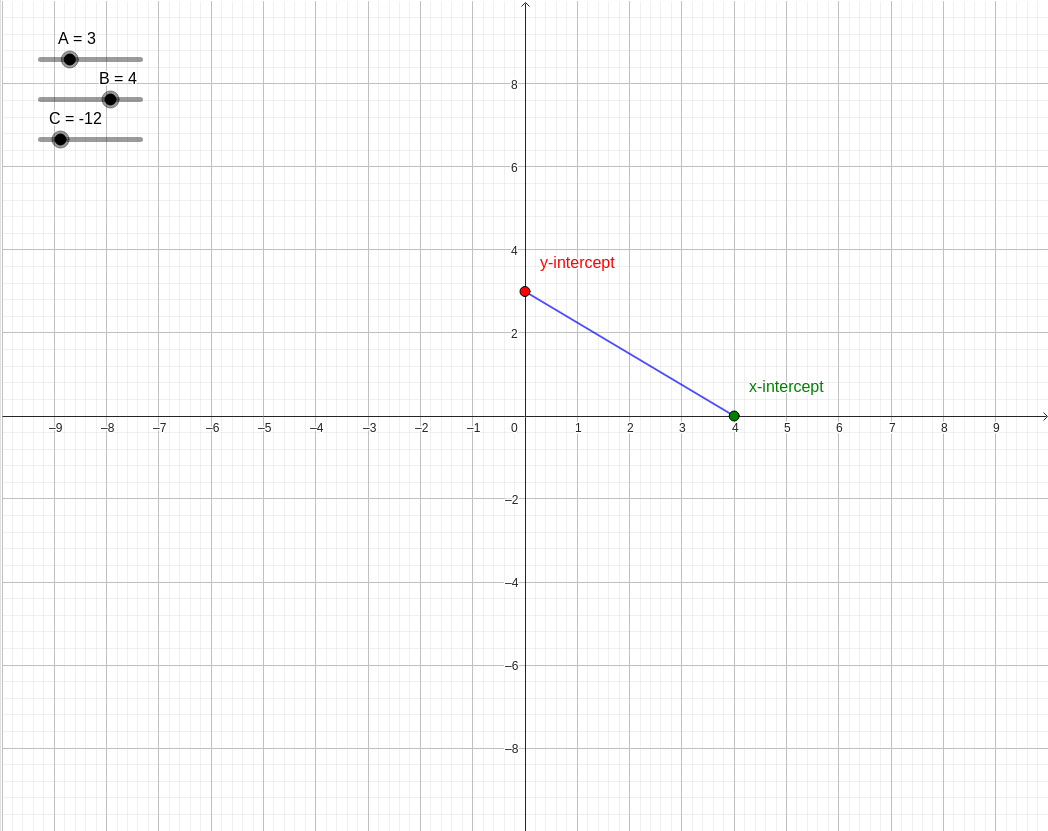
Question: explain General Form Ax + By + C = 0 (A, B, C ∈ ℤ and A > 0) Fast Coefficients Read (Paper 2): • Slope m = −A/B • y-intercept = −C/B • x-intercept = −C/A
In the HKDSE Compulsory Part, the General Form of a straight line is the most standard way to express a linear relation. While the Slope-Intercept form (
) is intuitive for graphing, the General Form
is often used in coordinate geometry questions involving circles and intersections.
1. Derivation and Algebraic Transformation
To understand why the "fast coefficients" work, we transform the General Form into the Slope-Intercept form.
By comparing this to the standard
:
- Slope ( ): The coefficient of , which is .
- -intercept ( ): The constant term, which is .
2. Calculating Intercepts
An intercept occurs when the line crosses one of the axes.
- -intercept: Occurs when .
- -intercept: Occurs when .
3. Examiner's Tips for Paper 2 (Multiple Choice)
In the DSE Paper 2, speed is critical. You should be able to identify the properties of a line at a glance:
- Sign of Slope: If and have the same sign, the slope is negative (the line goes "downhill"). If they have opposite signs, the slope is positive ("uphill").
- Vertical/Horizontal Lines:
- If , the line is horizontal ( ).
- If , the line is vertical ( ).
- The "A > 0" Convention: By keeping positive, the sign of directly tells you the direction of the line. For example, in , (positive) and (negative), so the slope is , which is positive.
Visual Guide
In the diagram below, you can manipulate the values of
and
.
- The Blue Line represents the equation .
- The Red Point indicates the -intercept .
- The Green Point indicates the -intercept .
- Observe how changing affects the steepness (slope) and how changing shifts the line without changing its slope.