The Math of a Perfect Free Throw (Parabolic Trajectory)
Grades 9-10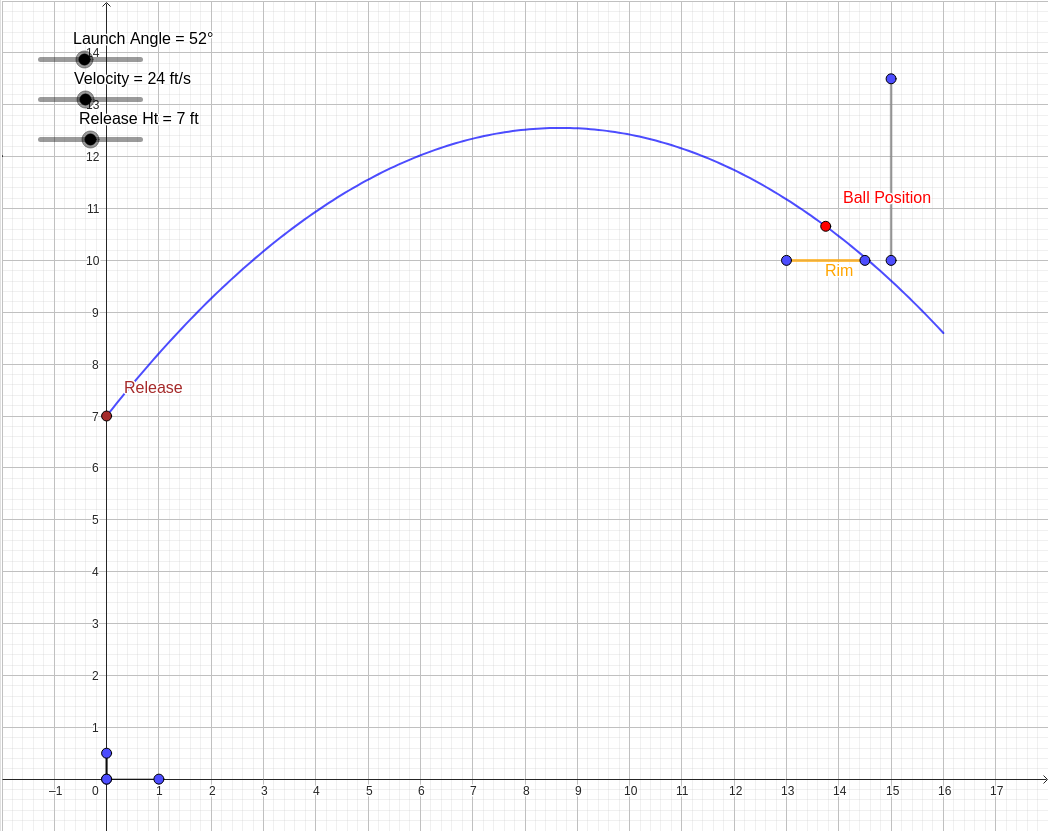
Question: Perfect free throw trajectory
Achieving the perfect free throw is a beautiful intersection of physics and geometry. When a basketball player shoots from the free throw line, the ball follows a parabolic trajectory determined by three primary factors: the release height, the launch angle, and the initial velocity.
The Physics of the Shot
The motion of the ball can be split into two components:
- Horizontal Motion: The ball moves at a constant speed toward the hoop (neglecting air resistance).
- Vertical Motion: The ball is subject to gravity, which pulls it downward at a constant acceleration ( ). This creates the characteristic curve known as a parabola.
The Importance of the "Entry Angle"
The most critical factor for a "swish" is the entry angle—the angle at which the ball passes through the rim.
- The Problem: A basketball hoop has a diameter of 18 inches, while a standard ball is roughly 9.5 inches. If the ball enters perfectly vertically ( ), it has the maximum possible space to fall through.
- The Constraint: As the entry angle decreases (a "flat" shot), the hoop appears as a smaller and smaller ellipse to the ball. If the angle is too low (below ), the ball physically cannot fit through the rim without hitting the edges.
- The "Goldilocks" Zone: Mathematical models suggest an optimal entry angle of approximately to . This provides a generous margin for error while requiring a manageable launch speed.
How to use the diagram:
- Release Height ( ): Adjust the height from which the ball is thrown. Taller players can often use lower launch angles because they are already closer to the rim's height ( ).
- Launch Angle ( ): Watch how a higher arc (steeper angle) changes the "steepness" of the entry into the hoop.
- Velocity ( ): This controls the power. You must balance velocity with your angle to ensure the peak of the parabola is correctly positioned.
- The Target: The Orange Segment represents the rim. Your goal is to make the Blue Trajectory pass through the center of the rim at and .
Observe the Entry Angle readout in the diagram. Notice how increasing the arc (Launch Angle) makes the ball drop more vertically into the basket, increasing your chances of success.