Fractal Tree Branching: The Geometry of Recursive Patterns
Grades 8-9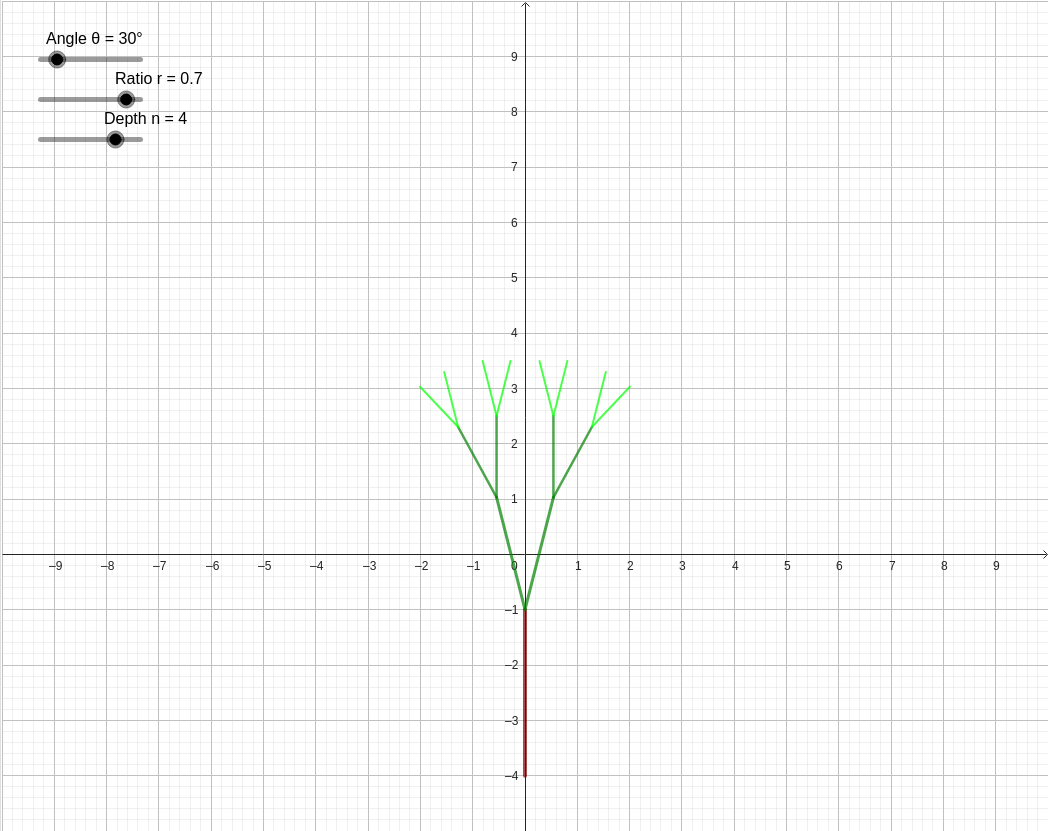
Question: Fractal branching of trees
Fractal branching is a mathematical process where a simple rule is repeated indefinitely to create complex, self-similar structures. This geometric concept is used to model the growth patterns of trees, river systems, and blood vessels. In a fractal tree, the "trunk" splits into smaller "branches," which in turn split into even smaller "sub-branches," maintaining a consistent relationship between the parent and child segments.
The Mathematics of the Fractal Tree
The construction of a symmetrical binary fractal tree is governed by three primary parameters:
1. The Branching Angle (
) This is the angle at which a child branch deviates from the direction of its parent. If the trunk grows vertically (90° from the horizontal), and the branching angle is 30°, the two child branches will grow at 60° and 120° respectively.
2. The Scaling Ratio (
) To maintain a natural appearance and ensure the structure remains bounded, each successive generation of branches is shorter than the previous one. If the initial trunk has length
, the next branches will have length
, then
, and so on. This forms a geometric progression:
where
is the length of a branch at level
.
3. Recursion Depth (
) This represents the number of times the branching rule is applied. In nature, this is limited by biological constraints, but mathematically, as
approaches infinity, the structure develops infinite detail.
Geometric Convergence
The total number of branches at any level
is
. The total length of all branches in the tree up to level
is given by the sum:
If
(meaning
), this series converges to a finite value even if the tree branches forever:
However, if
, the total combined length of the branches becomes infinite, creating a dense "canopy" that can eventually fill a two-dimensional area.
Visualizing the Growth
In the interactive diagram:
- The Brown segment represents the trunk (Level 1).
- The Green segments represent the primary and secondary branches.
- The Light Green segments represent the fine tips or "leaves" of the fractal.
- You can adjust the Angle slider to see how the tree spreads or narrows.
- The Ratio slider controls how quickly the branches shrink. Notice how a high ratio makes the tree appear much "fuller."
- The Depth slider allows you to see the levels of recursion being added one by one.
Observe how changing the angle transforms the tree from a narrow, pine-like structure to a wide, spreading oak-like shape.