Finding Unknowns in Polynomial Identities by Substitution
Question: If m and n are constants such that (mx + 2)(3 – 2x) – 10 = 2x^2 + nx – 4, find the value of n. can you make another example of this question such that using substitution is far more easy then actually expand it ?
To solve the identity
, we can use the method of comparing coefficients or the method of substitution.
1. Comparing Coefficients (Expansion Method)
First, expand the left-hand side (LHS) of the equation:
Now, we compare this to the right-hand side (RHS):
By comparing the coefficients of
:
By comparing the coefficients of
:
2. The Power of Substitution
Since this is an identity, it must be true for any value of
. A "clever" substitution can often bypass the need to find
first. Notice that if we set
(or
), the factor
becomes zero.
This method is faster because
is eliminated immediately!
A More Complex Example
Substitution is "far more easy" when the constants are large or involve decimals. Consider this problem:
Find
if
.
Method A: Expansion You would have to calculate
, then
, then find
from the
term, and finally combine everything to find
. This is prone to calculation errors.
Method B: Substitution We choose
because
.
Substitution turned a messy algebraic expansion into a simple linear equation.
Visualizing the Identity
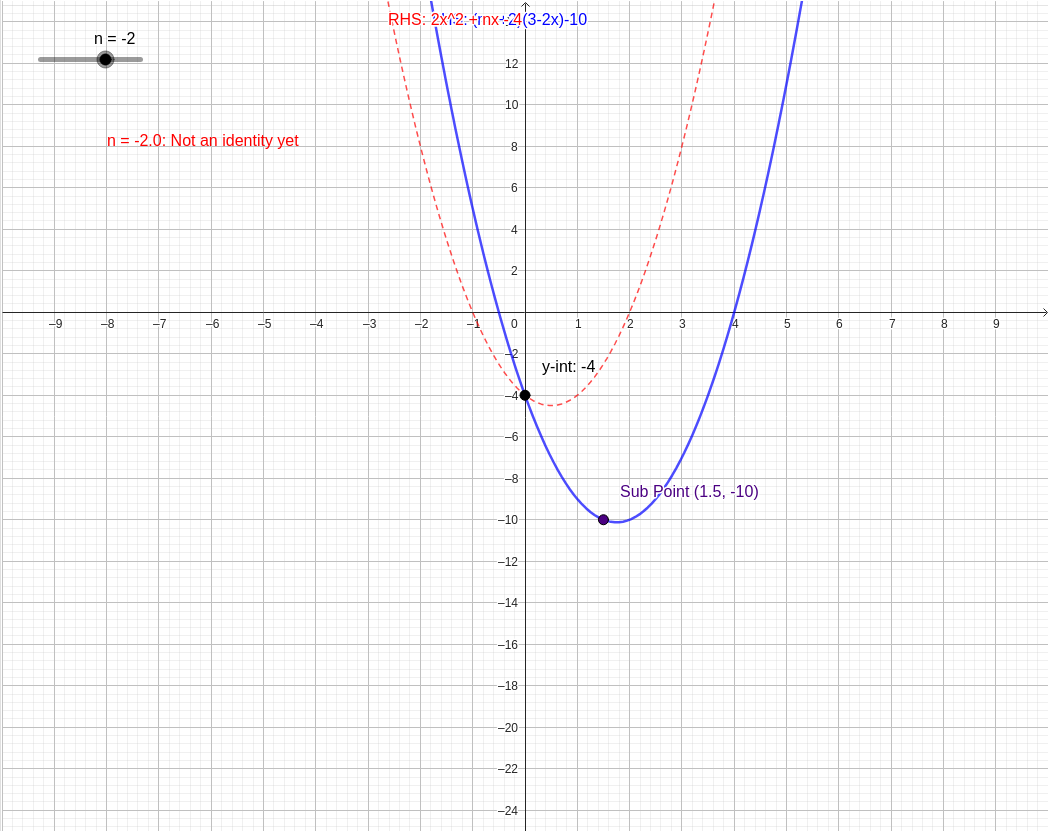
In the diagram below, the blue curve represents the LHS:
. The red curve represents the RHS:
. Since they are identical, they must lie exactly on top of each other. You can adjust the slider for
to see that the red curve only aligns perfectly with the blue curve when
.
Note the specific point
at
. Regardless of the value of
, the blue curve always passes through this point (
) because the first term vanishes.