Equilateral Triangle Divided into Equal Segments (Construction)
Grades 8-9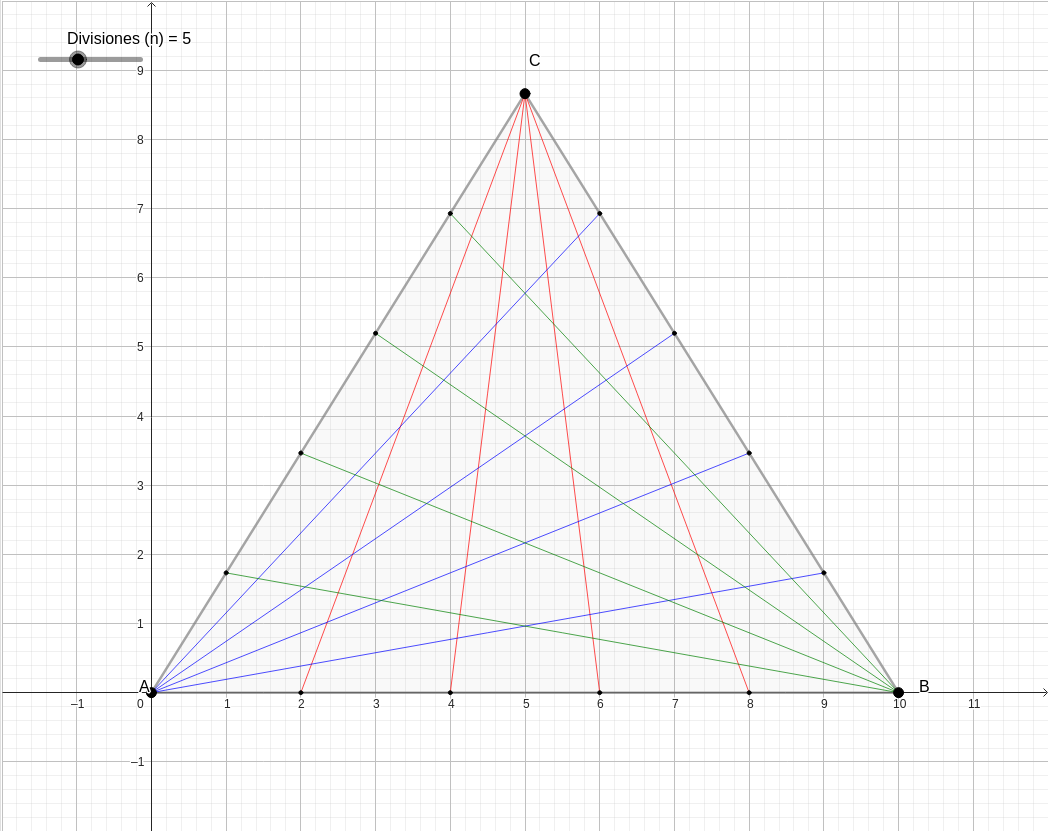
Question: Draw an equilateral triangle. Divide each side into five equal segments. Draw lines from each division point to the opposite vertex.
To construct this geometric figure, we start from the fundamental properties of an equilateral triangle and apply concepts of proportion and symmetry.
The Equilateral Triangle
An equilateral triangle is defined by having all three sides equal in length and all three interior angles equal to
. If we define the side length as
, the triangle's height
can be found using the Pythagorean theorem:
In the diagram, the main vertices are labeled
, and
.
Dividing the Sides
The problem asks us to divide each side into five equal segments. Mathematically, if a side has length
, each small section measures
. To achieve this, we place four division points on each side:
- Side : The points sit at distances of , and from vertex .
- Side : The points are distributed proportionally between vertices and .
- Side : The points are distributed proportionally between vertices and .
Drawing the Cevians
A cevian is any segment joining a triangle's vertex to the opposite side. In this construction:
- From vertex , we draw lines to the 4 points on the opposite side (shown in red).
- From vertex , we draw lines to the 4 points on the opposite side (shown in blue).
- From vertex , we draw lines to the 4 points on the opposite side (shown in green).
This network of lines creates a highly symmetric pattern inside the triangle. You can use the slider to see how the figure changes if you divide the sides into more or fewer parts (from 2 to 10 segments).
Visual Exploration:
- Vertices: Large points labeled , and .
- Division points: Small points along the triangle's edges.
- Intersections: Watch how lines of different colors cross inside the triangle, forming a deformed triangular grid that preserves rotational symmetry.