Right Triangle Labelled: Hypotenuse, Opposite and Adjacent
Grades 8-9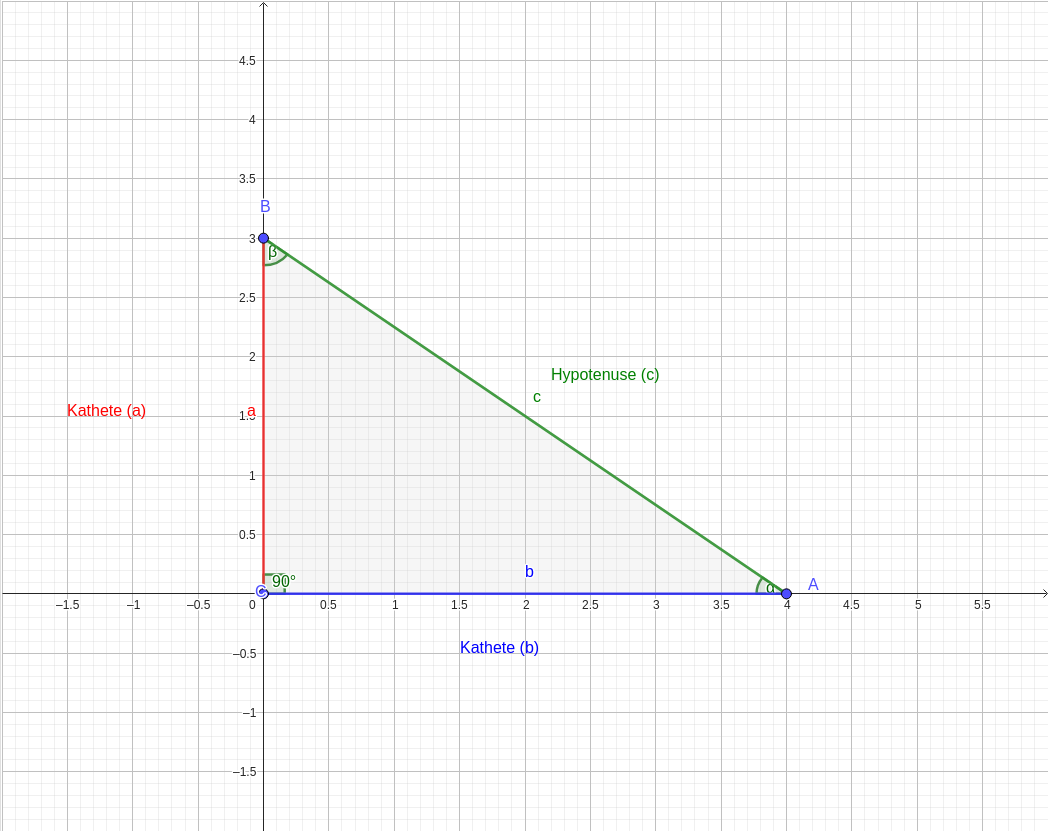
Question: Draw a right triangle and label it completely.
A right triangle is a special triangle in which one interior angle measures exactly
. This angle is usually denoted by the Greek letter
and marked with a small square (the right-angle symbol).
Here are the key parts and labeling conventions for a right triangle:
- Vertices: These are usually labeled counterclockwise with the capital letters , , and . In the standard layout, the right angle sits at vertex .
- Sides: Sides are named with lowercase letters, matching the vertex opposite them.
- Hypotenuse ( ): The triangle's longest side. It lies directly opposite the right angle.
- Legs ( and ): The two shorter sides that form the right angle are called the legs. Relative to one of the acute angles (say ), we further distinguish between the adjacent leg (next to the angle) and the opposite leg (across from the angle).
- Angles: The interior angles at vertices and are labeled and . Since every triangle's angles sum to and the right angle already takes up , and must together also sum to ( ).
The diagram below shows such a triangle with all the standard labels, including the names for each type of side.