Properties of a Parallelogram, with an Interactive Diagram
Grades 8-9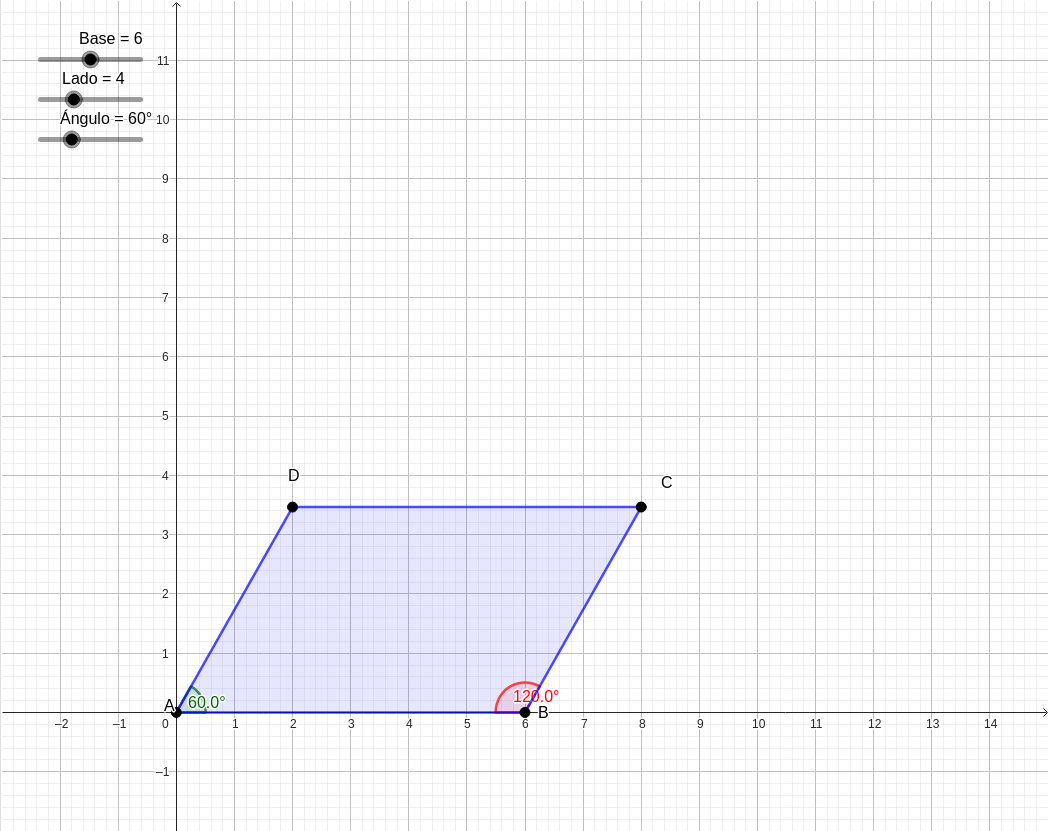
Question: Draw a parallelogram ABCD.
A parallelogram is a special type of quadrilateral whose opposite sides are parallel and equal in length. In the interactive diagram, you can observe the following fundamental properties that define this figure:
- Parallel, Equal Sides: Opposite sides are parallel to each other. Mathematically, this means segment is parallel to ( ) and segment is parallel to ( ). Their lengths are also identical: and .
- Consecutive Angles: Angles that share a side (such as the angle at and the angle at ) are supplementary. Their sum is always :
- Opposite Angles: Angles at opposite vertices are equal to each other ( and ).
To find the coordinates of the fourth vertex
so the figure is always a parallelogram, we can use the vector relationship
, or simply add the vector from
to
to point
:
In the interactive construction, you can adjust the sliders to change the base length, the side length, and the tilt angle, and watch how these geometric properties are preserved.