Isosceles Trapezoid: Finding the Height from Its Sides
Grades 8-9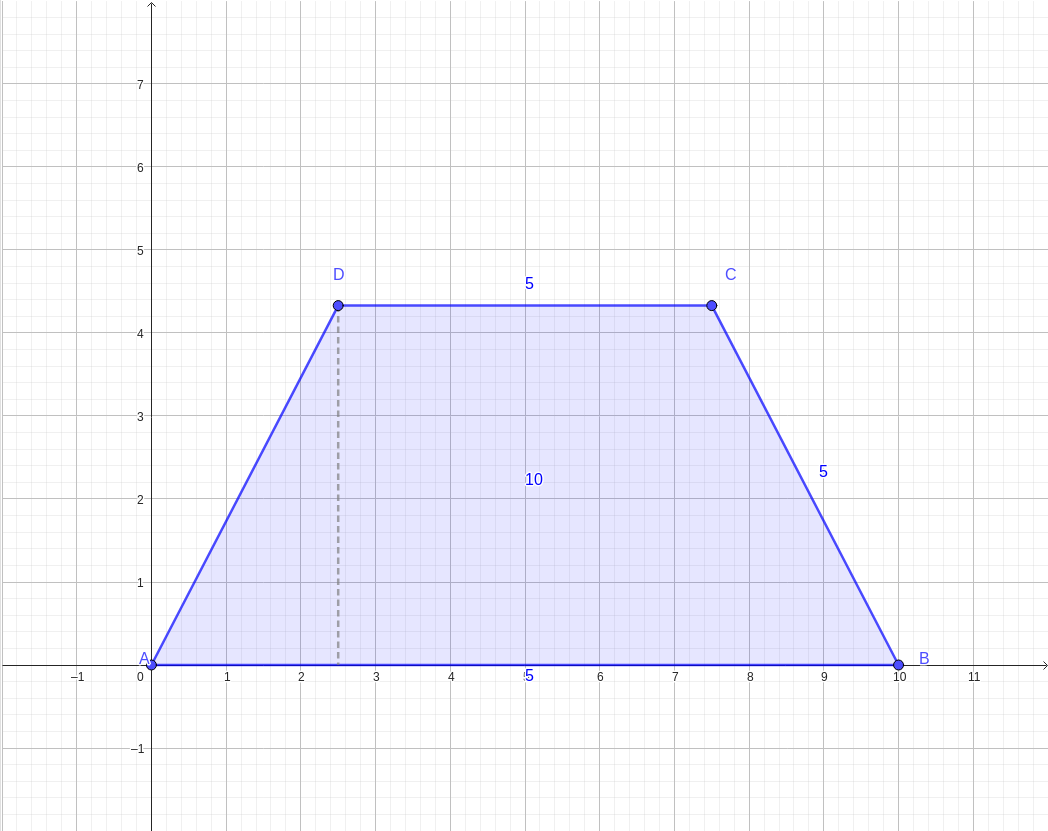
Question: Draw a trapezoid ABCD, with AB and CD as the bases. Make AD = DC = CB = 5 and AB = 10.
To construct a trapezoid with the given dimensions (
and
), we first need to identify its geometric properties. Since the non-parallel sides
and
are equal, this is an isosceles trapezoid.
To determine the exact position of the top vertices (
and
), we can follow this reasoning:
-
Computing the base and height: If we drop perpendiculars from and to the longer base , call the intersection points and . Since the trapezoid is symmetric, segment equals segment . Since the top base measures and the bottom base measures , the leftover space along the longer base is . This space splits evenly between the two sides:
-
Using the Pythagorean Theorem: In right triangle , we know the hypotenuse ( ) and one leg ( ). The trapezoid's height ( ) is:
In the diagram, the trapezoid is highlighted in blue. The labels show that the bottom base is twice the length of the top base, and the three remaining sides are identical, forming a perfectly symmetric figure.