Shortest Path on a Cylinder (Unfolded Net Method)
Grades 10-11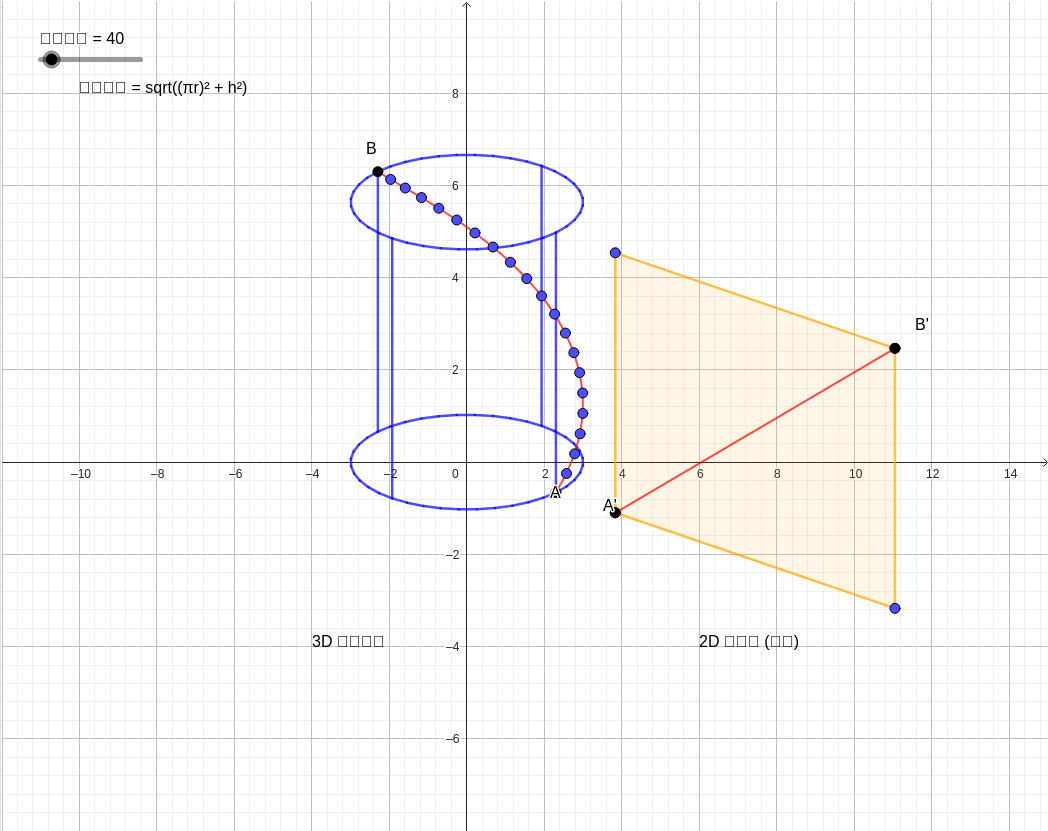
Question: Solid geometry: shortest path on an unfolded cylinder
To find the shortest path between two points on a cylinder's surface, we need to "unfold" its lateral surface into a flat shape. Here's the core mathematical logic:
1. The Unfolding Principle
A cylinder's lateral surface is curved, but geometrically it's a "developable surface". If we cut it along one straight line (a generator) and lay it flat, it becomes a rectangle.
- The rectangle's height equals the cylinder's height .
- The rectangle's width equals the base circle's circumference .
2. Mapping the Path Between Two Points
Suppose start point
lies on the bottom circle and end point
lies on the top circle, directly opposite
(i.e., halfway around the cylinder):
- In 3D space, this path looks like a helix spiraling up the cylinder (the red curve).
- On the unfolded rectangular grid, the positions of
and
change:
- The horizontal distance becomes half the base circumference, .
- The vertical distance is still the cylinder's height, .
3. Computing the Shortest Path
Since "a straight line is the shortest distance between two points" in plane geometry, the straight segment connecting
and
on the unfolded diagram is the shortest path.
Using the Pythagorean theorem, we can compute the path length
:
Diagram Key
- Left, 3D model (blue): Shows the cylinder and the helical path on its surface. Drag the rotation slider to see the relative positions of and .
- Right, unfolded diagram (yellow): Shows the rectangle formed by flattening the lateral surface. The red straight segment makes the nature of the shortest path immediately visible.
- Key points and : In the 3D view they sit on opposite sides of the cylinder; in the unfolded view they're connected across the rectangle's diagonal.
Looking at the unfolded diagram, you can see that any path that looks complicated on a curved surface reduces to the simplest possible straight-line logic once you "flatten" it.