Golden Angle and Phyllotaxis: The Math of a Succulent
Grades 8-9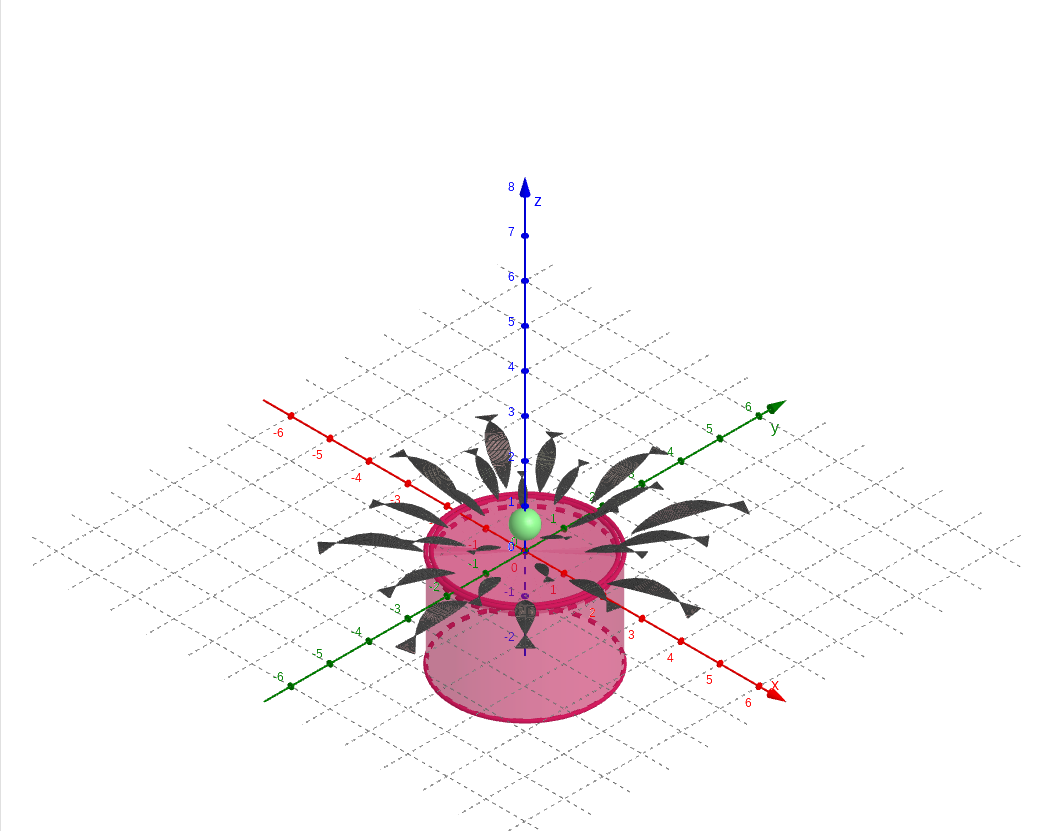
Question: draw a succulent. make it cute. change the colours
To create this cute succulent, we use principles of phyllotaxis, which is the arrangement of leaves on a plant stem. In nature, many succulents like the Echeveria follow a spiral pattern governed by the Golden Angle (approximately
). This allows the plant to pack its leaves tightly without them shading each other perfectly, ensuring each leaf gets sunlight.
Mathematical Elements of the Succulent
- The Rosette Pattern: We arrange the leaves using a spiral coordinate system. For each leaf , the angle is calculated as , and the radius increases proportionally to . This creates the iconic "mandala" look of the plant.
- Leaf Geometry: Each succulent leaf is modeled as a thickened parametric surface. Unlike thin petals, succulent leaves are "fleshy." We use mathematical functions to define a teardrop shape that is slightly curved upwards and has volume.
- The Pot and Soil: The base is a truncated cone (representing a terracotta pot) and a cylinder (representing the soil). These provide a sturdy geometric foundation for the organic shapes above.
- Color Theory: To make it "cute," we use a pastel palette. The pot is a soft coral, the soil is a deep umber, and the leaves transition from a mint green at the base to a rosy pink at the tips, mimicking the way real succulents "blush" under bright light.
Observe how the leaves overlap more closely near the center (the "heart" of the succulent) and spread out as they grow older and larger towards the edges.