How to Construct a Penrose Tiling
Grades 10-11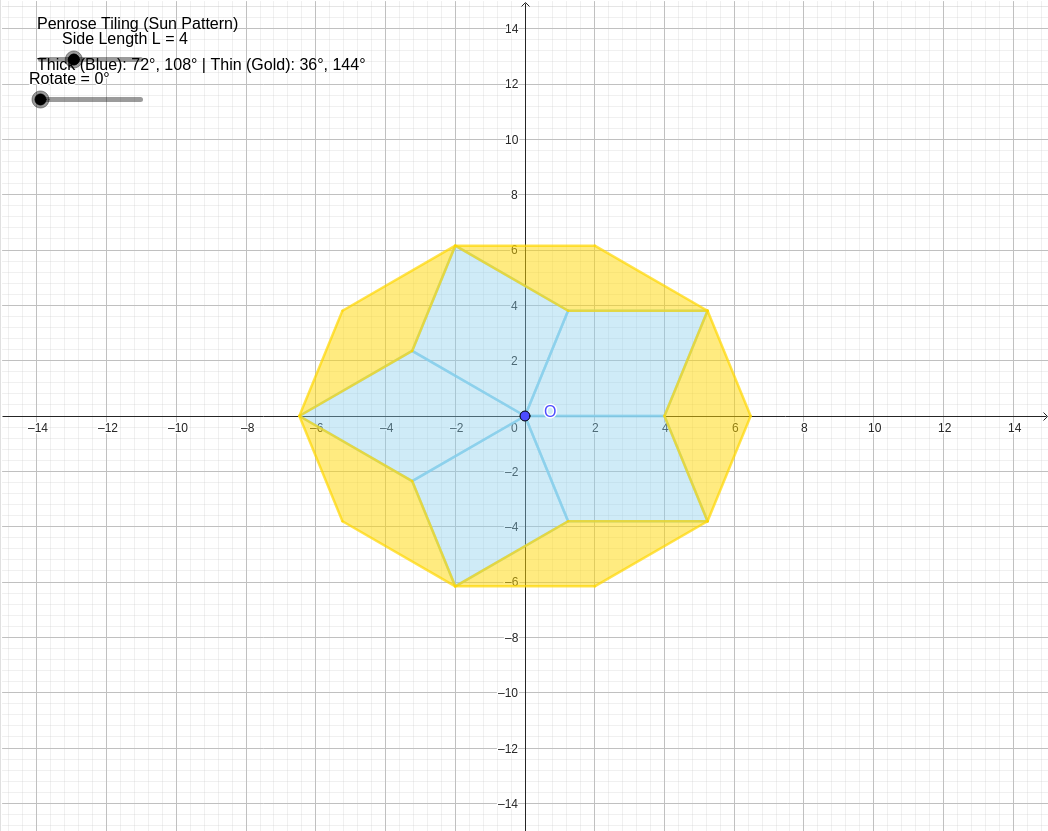
Question: Create a Penrose tiling
A Penrose tiling is a fascinating example of a non-periodic tiling of the plane. Unlike regular tilings (like squares or hexagons) that repeat in a predictable, translational pattern, a Penrose tiling never repeats itself exactly, yet it can cover an infinite area without gaps. It is characterized by five-fold rotational symmetry, which was long thought to be impossible for crystals until the discovery of "quasicrystals."
Mathematical Components
The most common version of this tiling (the P3 tiling) uses two specific rhombi:
- The Thick Rhomb (Blue): This rhomb has interior angles of and . It can be thought of as two "Golden Triangles" joined at their bases.
- The Thin Rhomb (Yellow): This rhomb has interior angles of and .
The Golden Ratio ( )
The geometry of these tiles is governed by the Golden Ratio,
. This ratio appears in several ways:
- The ratio of the area of a thick rhomb to a thin rhomb is exactly .
- In a thick rhomb, the ratio of the long diagonal to the side length is .
- In a thin rhomb, the ratio of the side length to the short diagonal is .
Matching Rules and the "Sun" Pattern
To ensure the tiling remains non-periodic, the tiles must be joined according to "matching rules," often visualized as circular arcs of different colors on the vertices. If these arcs do not align to form a continuous curve, the placement is invalid.
The diagram below displays a Sun pattern, a central patch of a Penrose tiling where five thick rhombs meet at a single point (forming a
center, as
). The gaps between these thick rhombs are perfectly filled by five thin rhombs (
at the meeting vertices).
- Interaction: Use the Side Length ( ) slider to scale the tiling and observe how the proportions and angles remain constant.
- Visual Logic: Notice how the vertices align to form a star-like structure that exhibits symmetry, yet lacks the simple repeating grid of standard floor tiles.