Concave Lens Ray Diagram: Image Position and Magnification
Grades 10-11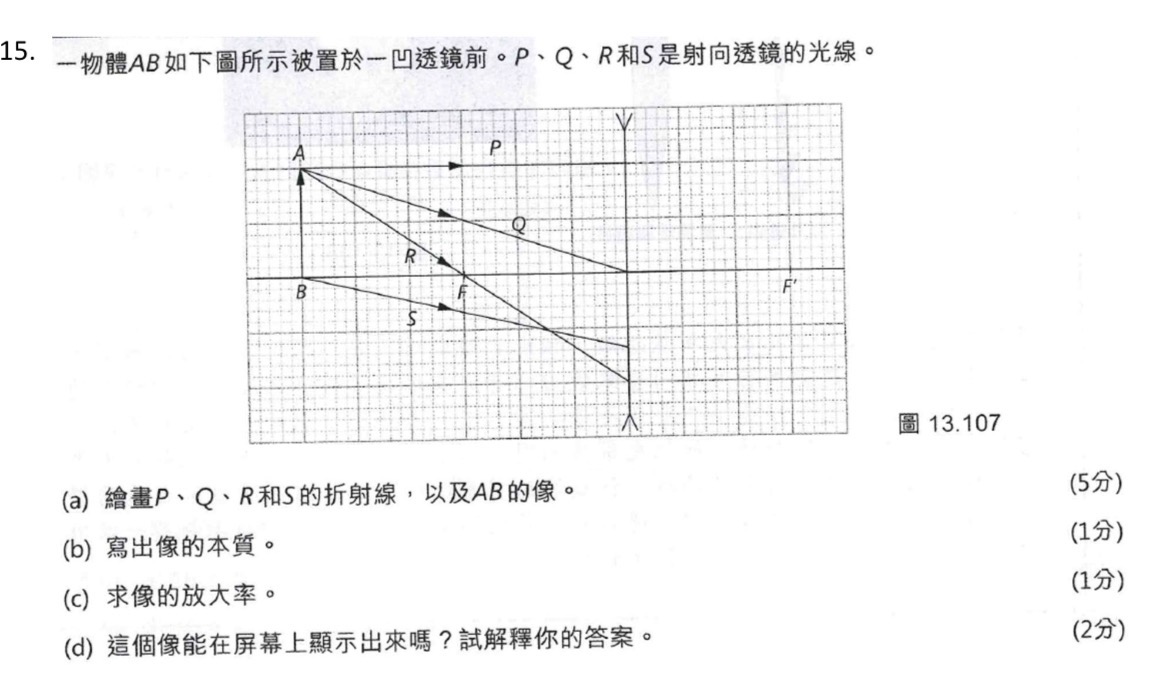
Question: Please explain this in detail.
This is a physics problem about image formation with a concave (diverging) lens. We can use the ray-diagram method from geometric optics, drawing two of the three "principal rays" to locate the image.
(a) Construction Analysis and Steps
On the grid, we place the lens's optical center at the origin
.
- Object : the base sits on the principal axis, grid units from the lens (object distance ); the top has a height of grid units (object height ).
- Focal point : located grid units to the left of the lens (focal length ).
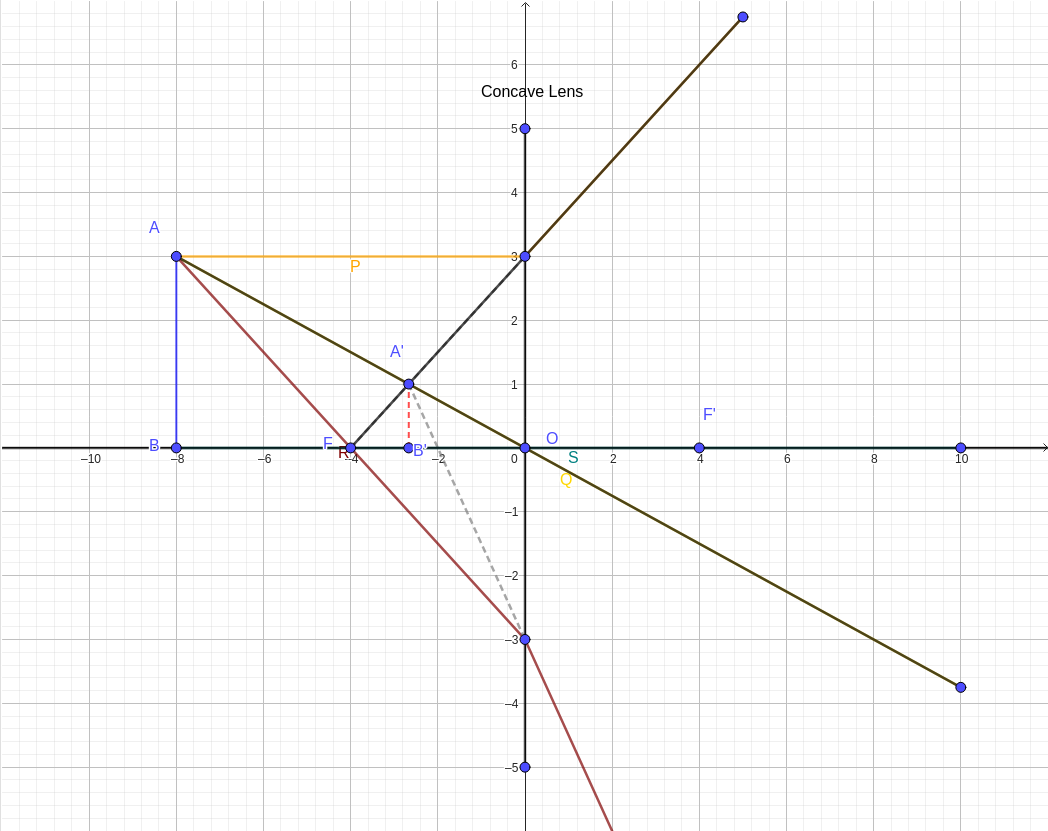
- Ray P (parallel to the axis): This ray travels to the point on the lens. Because of the concave lens's properties, it refracts outward (diverges), and its backward extension must pass through the virtual focal point on the left.
- Ray Q (through the optical center): A ray through the lens's center passes straight through unchanged.
- Locating the image : The intersection of the two refracted rays (or their backward extensions) gives the image point . From the diagram, sits about grid units in front of the lens, with a height of exactly grid unit.
- Rays R and S:
- Ray R: travels from through toward the bottom of the lens. After refraction, it also appears to originate from image point .
- Ray S: travels along the principal axis, unaffected by refraction.
(b) Properties of the Image
From the construction, the image has three characteristics:
- Upright
- Diminished
- Virtual
(c) Magnification
The magnification formula is
.
Reading the values directly from the grid:
- Object height units
- Image height unit
- Magnification
(d) Can It Be Projected on a Screen?
Answer: No.
Explanation: this is a virtual image. The refracted rays from a concave lens diverge behind the lens and never actually converge at a real point in space, so no image can form on a screen. We can see the image because our eyes receive the diverging rays and our brain traces them backward to a perceived convergence point.
The diagram below shows the ray-refraction paths and how the virtual image forms: