Circumcentre of a Triangle: Interactive Perpendicular Bisectors
Grades 9-10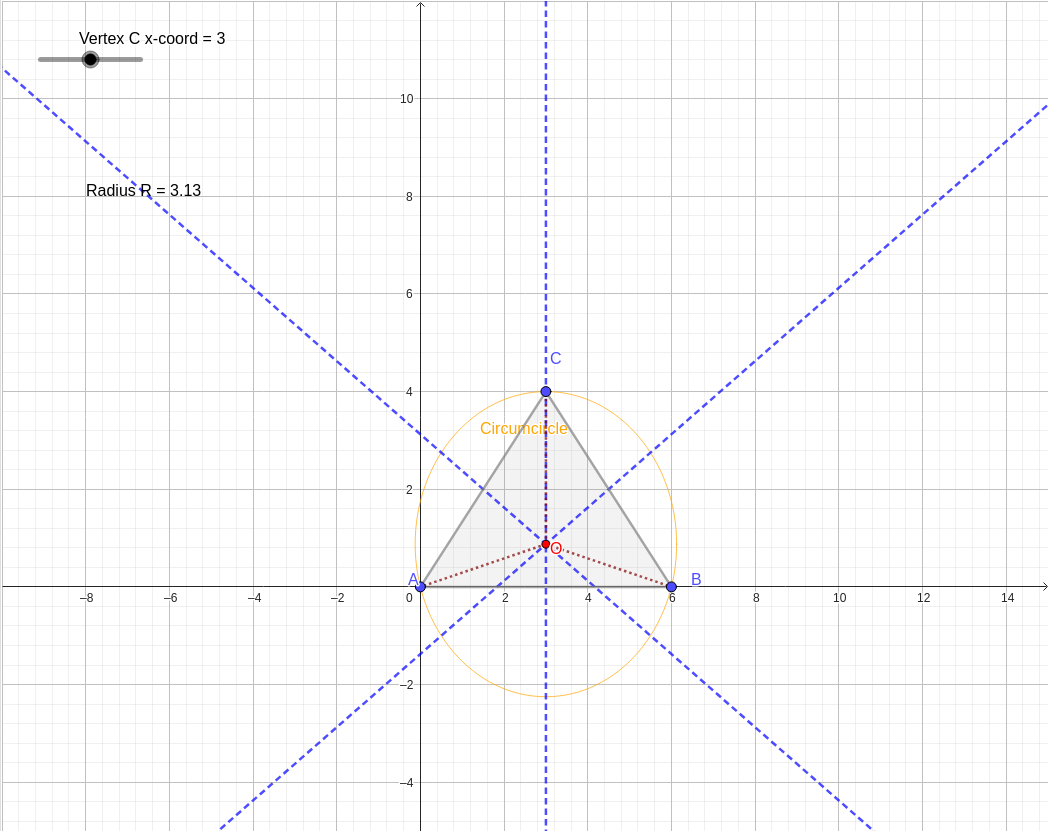
Question: visualize Circumcentre with slider
In the study of coordinate geometry and the properties of triangles in the HKDSE, the circumcentre is one of the four centers of a triangle that students must master. It is defined as the point of intersection of the perpendicular bisectors of the three sides of a triangle.
1. Mathematical Properties
The circumcentre (often denoted as
) has several unique properties:
- Equidistance: The circumcentre is equidistant from all three vertices of the triangle. That is, , where is the circumradius.
- The Circumcircle: Because it is equidistant from the vertices, it serves as the centre of a circle that passes through , , and , known as the circumcircle.
- Geometric Construction: To find the circumcentre, we construct the perpendicular bisectors of at least two sides. The point where they meet is the circumcentre .
2. Position Relative to the Triangle
The position of the circumcentre depends entirely on the type of triangle:
- Acute Triangle: The circumcentre lies inside the triangle.
- Right-angled Triangle: The circumcentre lies exactly on the midpoint of the hypotenuse. This is consistent with the theorem that the angle in a semi-circle is a right angle .
- Obtuse Triangle: The circumcentre lies outside the triangle, specifically on the opposite side of the longest side from the obtuse angle.
3. Visualization Guide
In the following diagram:
- Vertices and are fixed on the -axis.
- Vertex moves horizontally via the slider .
- The blue dashed lines represent the perpendicular bisectors of the sides.
- The red point is the circumcentre.
- The orange circle is the circumcircle.
By moving the slider, you can observe the circumcentre shifting. Notice how it "exits" the triangle when the vertex
moves far enough to create an obtuse angle at
or
. When the triangle is right-angled (e.g., when
is directly above
), the circumcentre sits perfectly on the midpoint of the side
.
助提示 (DSE Tip): In Paper 1 long questions, if you are asked to find the coordinates of the circumcentre, you should either:
- Equate the distances: .
- Find the equations of two perpendicular bisectors and solve them as simultaneous equations.
要求: [
bisector of chord passes through centre]