Intersection of a Line and a Circle: Fastest Method
Grades 10-11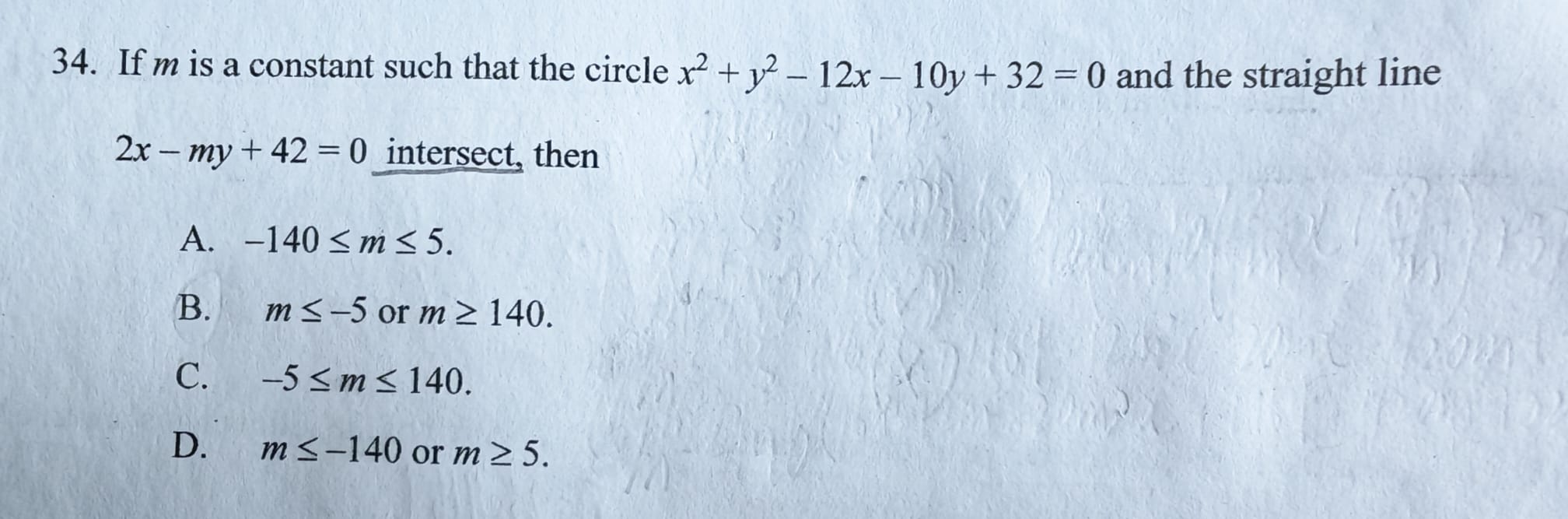
Question: can you teach me the fastest method to find the answer
To find the answer to this problem efficiently, the fastest method is to use the geometric property of circles and lines: the distance from the center of the circle to the line.
1. Identify the Circle Properties
First, we find the center and radius of the circle given by the equation
.
- The center is found by taking half the coefficients of and and changing their signs: So, the Center is .
- The Radius is calculated using :
2. The Intersection Condition
A line
intersects a circle if the perpendicular distance
from the center of the circle to the line is less than or equal to the radius.
If
, the line is too far away to touch the circle.
3. Apply the Distance Formula
The perpendicular distance from the center
to the line
is:
4. Solve the Inequality
Square both sides to eliminate the absolute value and the square root:
Divide by 4:
Since the expression is "greater than or equal to zero,"
must lie outside the roots
and
. Therefore,
or
.
The correct answer is D.
Visualizing the Geometry
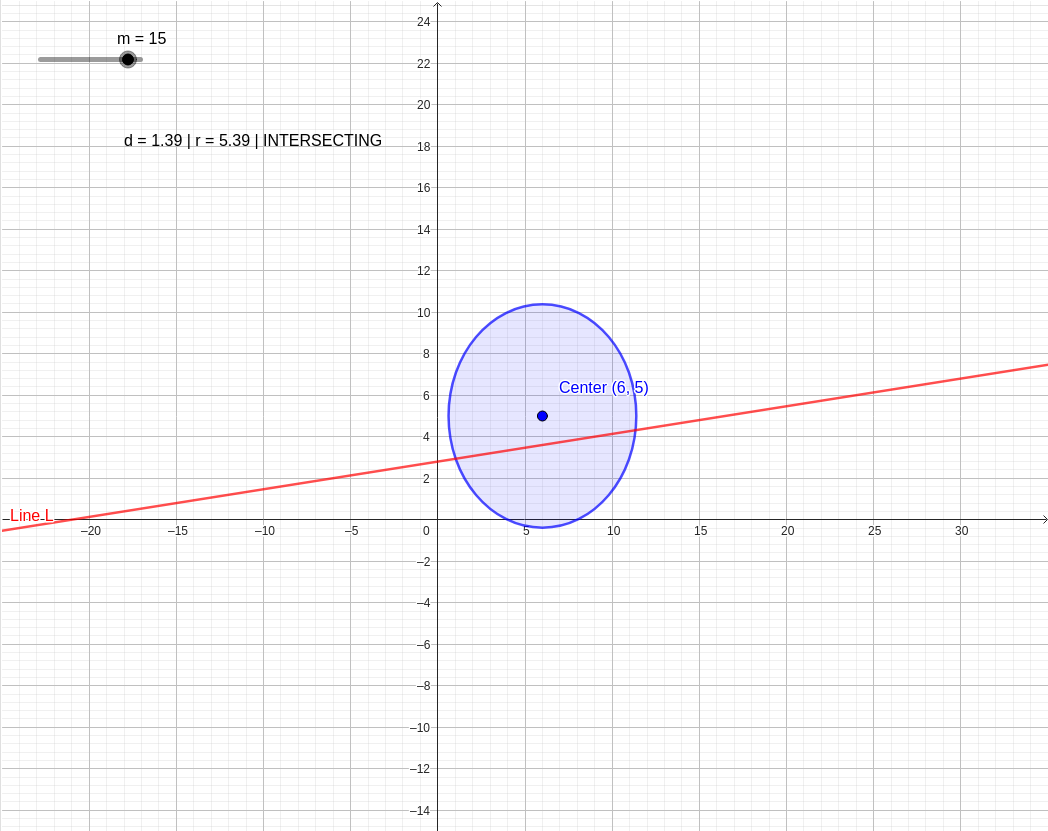
In the diagram below, you can see the Circle (in blue) and the Line (in red). The center is marked at
. As you adjust the slider for
, notice that the line only touches or enters the circle when
reaches the "critical" boundary values of
or
. Outside this range, the distance
from the center to the line becomes greater than the radius, and they no longer intersect.