Finding the Intersection Area of Two Circles
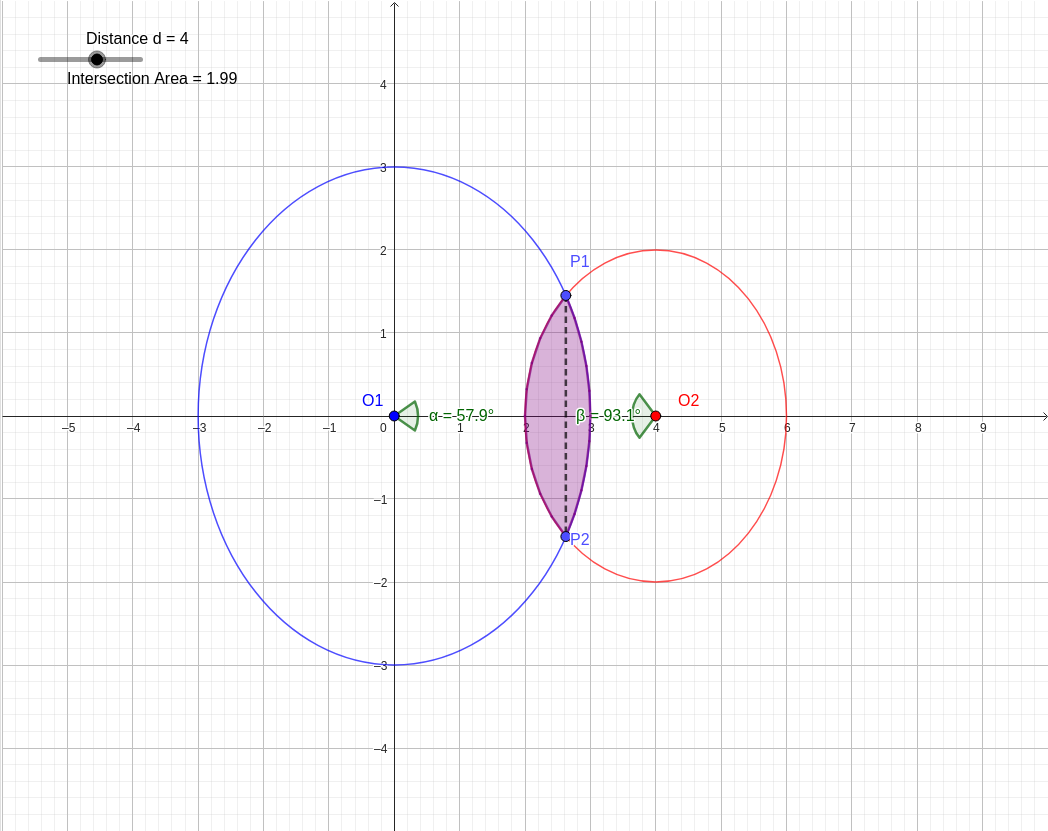
Question: Intersection area of two shapes in plane geometry
Finding the intersection area of two geometric shapes is a fundamental problem in plane geometry. The intersection region (often called a lens when dealing with two circles) is the set of all points that lie within both boundaries.
To calculate this area, we generally follow these steps:
- Find the Intersection Points: Determine where the boundaries of the two shapes meet. For two circles, this is done by solving their equations simultaneously, which typically yields two points of intersection.
- Identify the Boundaries: The overlapping region is bounded by segments of the original shapes' perimeters (e.g., circular arcs or line segments).
- Decompose the Area: For complex shapes, we often divide the intersection into simpler parts, such as triangles and circular segments.
- Calculate via Geometry or Integration:
- Geometric Method: For two circles, the intersection area is the sum of two circular segments. Each segment's area is found by taking the area of a circular sector and subtracting the area of the triangle formed by the center and the intersection points.
- Calculus Method: We can integrate the difference between the upper and lower boundary functions between the x-coordinates of the intersection points:
Geometric Components of Circle-Circle Intersection
In the accompanying diagram:
- Circle 1 (Blue) and Circle 2 (Red) overlap to form a Purple Lens.
- The Common Chord (dashed line) connects the two intersection points and . This chord divides the lens into two circular segments.
- The distance between the centers determines the size of the overlap. If , the area is zero. If , one circle is completely inside the other.
- The Central Angles ( and ) subtended by the chord at each center are used to calculate the area of the circular segments: where is the central angle in radians.
You can adjust the slider to see how the intersection area changes as the shapes move closer or further apart.