Jensen's Inequality Proof for f(t) = t²
Grades 11-12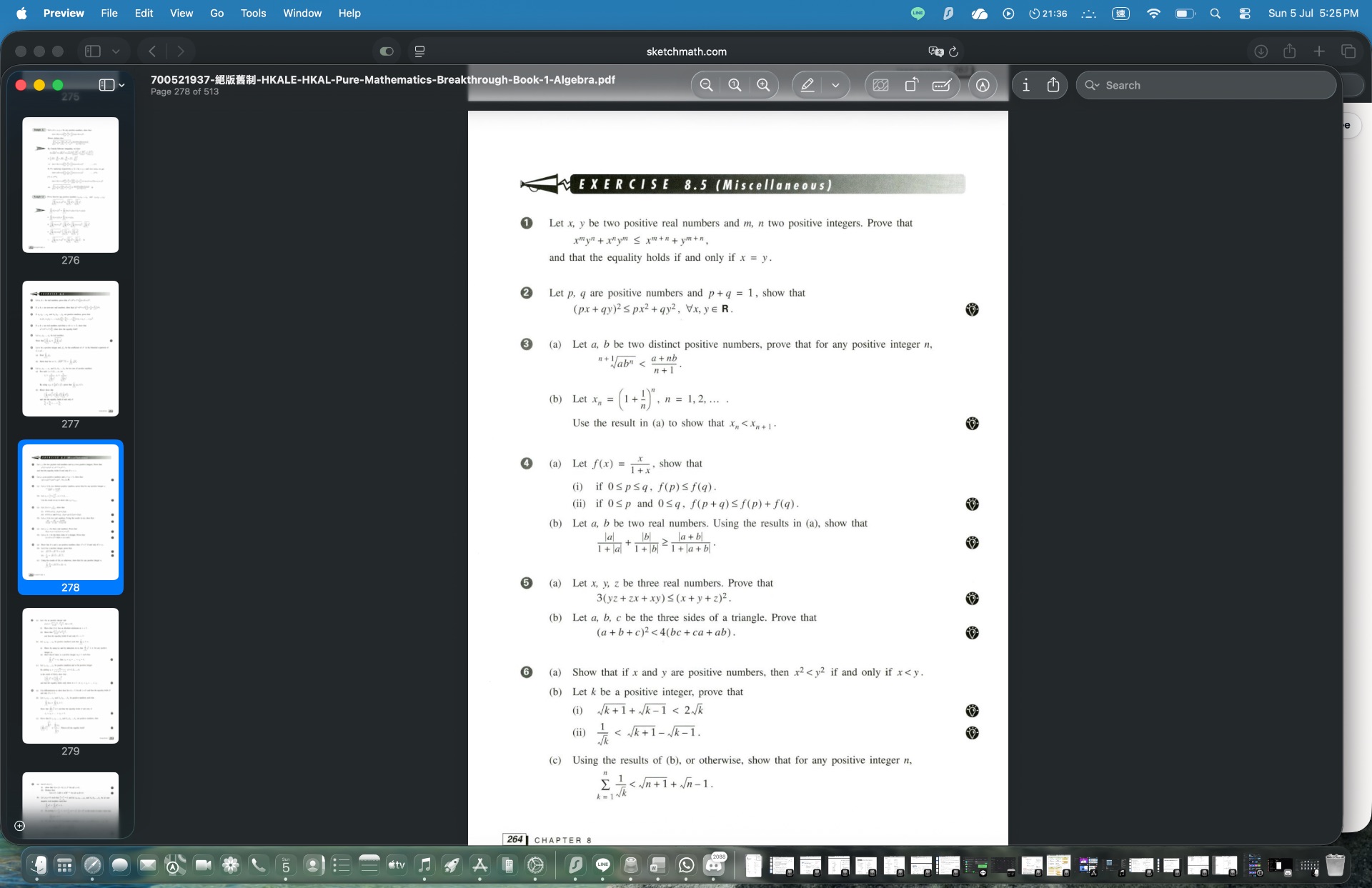
Question: Q2
This inequality is a fundamental property of convex functions, often known as Jensen's Inequality for the specific function
.
1. Algebraic Verification
We can prove the inequality by examining the difference between the right-hand side and the left-hand side. Let
. Then:
Since
, we have
and similarly
. Substituting these in:
Since
and
are given as positive numbers and
is always non-negative for any real
, the product
. This confirms that:
Equality holds if and only if
.
2. Geometric Interpretation
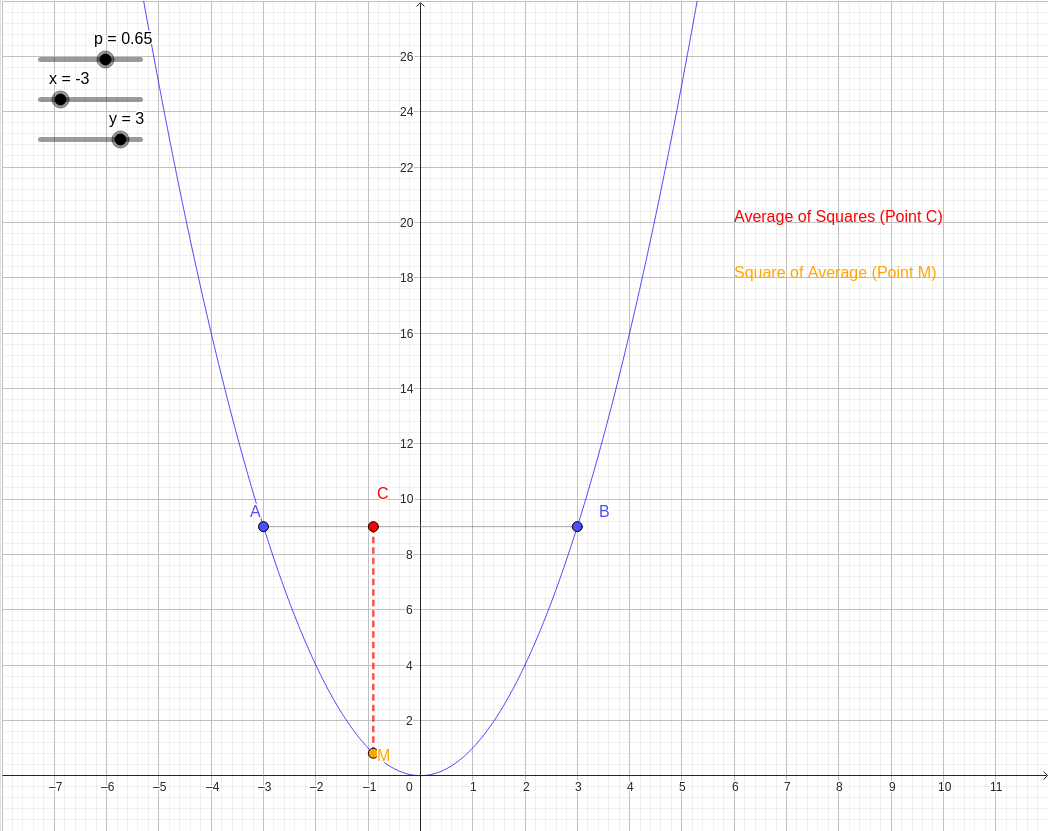
Visually, this relationship can be understood through the graph of the parabola
, which is a convex curve (it "curves upward").
- The Points A and B: On the blue parabola, let point A represent and point B represent .
- The Weighted Average C: Because , any point defined by must lie on the straight line segment (the chord) connecting A and B. This point is labeled C in the diagram. The height (y-coordinate) of C represents the average of the squares: .
- The Curve Point M: Now consider point M on the parabola directly below C. Its x-coordinate is the same, , but its y-coordinate is the square of that average: .
- Convexity Principle: Because the parabola is convex, the chord connecting any two points on the curve always lies on or above the curve itself. Therefore, point C is always at or above point M. This directly shows that the "average of the squares" (height of C) is always greater than or equal to the "square of the average" (height of M).
As you move the sliders for
, or the weight
, you will see that the red point C remains above the orange point M, only touching it when
.