Maximum and Minimum of xy: Finding the Integer Bounds
Grades 10-11
Question: Please give me a detailed step-by-step explanation.
This problem explores the extreme values of the two-variable function
under given absolute-value inequality constraints. We can work through it both geometrically and algebraically:
1. Determining the Ranges of and
First, we rewrite the absolute-value inequalities as intervals:
- For :
- For :
This means the points
lie inside a rectangular region whose sides are parallel to the axes. Since
are positive integers, this rectangle spans multiple quadrants (for example, the
-range includes positive values, while the
-range includes negative values).
2. The Extreme Value Principle
For the function
(a bilinear function), the maximum and minimum over a rectangular region always occur at one of the rectangle's four corners.
The four corners are:
3. Computing the Product at Each Corner
We compute the
product at each of the four points:
4. Setting Up the Equations
Since
, looking at the four expressions above:
- Minimum: clearly is the most negative term (since and are both the largest positive factors). This gives:
- Maximum: the maximum occurs at either or . Factoring into primes: .
This gives two possible combinations:
- Case 1: and Checking the maximum: The maximum here is , matching the target.
- Case 2: and Checking the maximum: The maximum here is also , matching the target.
5. Conclusion
Based on this derivation, the positive integer solutions for
and
are:
or
.
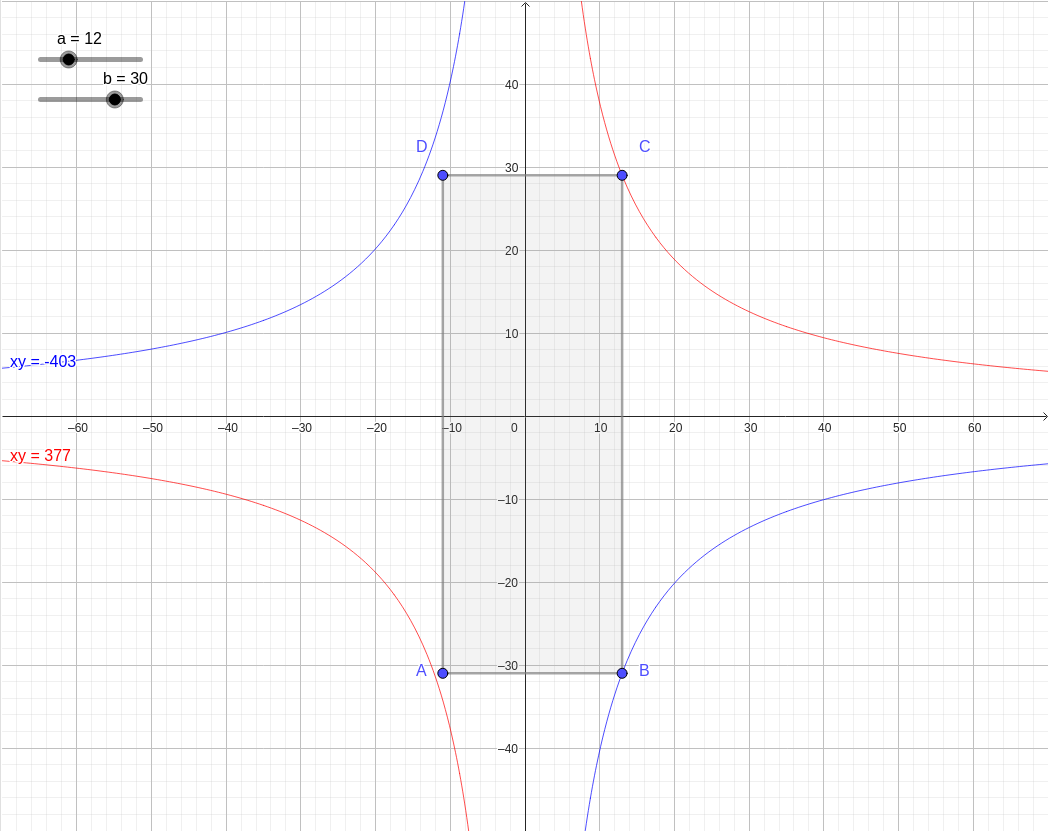
In the interactive graph below, you can adjust the sliders for
and
. When set to
and
, you'll see the rectangle's corners land exactly on the hyperbolas
(red) and
(blue).