Volume Surface Area Pyramid
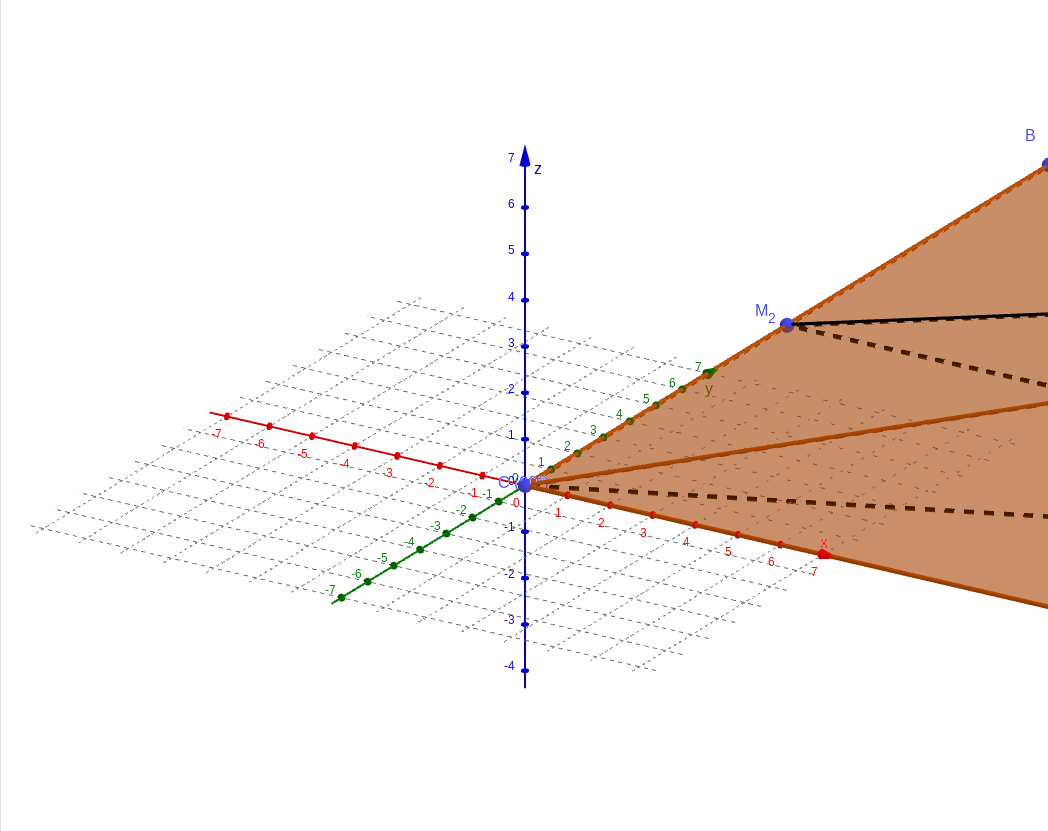
Interactive Volume Surface Area Pyramid graph — click to explore
Click the graph to explore it interactively →
Question: A triangular pyramid has a height of 6 cm. The foot of the altitude is located at the circumcenter of the triangular base. The perimeter of the base is 120 cm, and the three base edges are in the ratio 5:12:13. Calculate the volume and total surface area of the pyramid. Draw a clear 3D diagram, label the base edges, the height, the circumcenter of the base, and the slant heights. Show hidden edges with dashed lines.
To find the volume and total surface area of the triangular pyramid, we analyze the geometry of the base and lateral faces step by step.

Step 1: Determine the Dimensions of the Base Triangle

Let the lengths of the three edges of the base triangle \Delta ABC be 5k, 12k, and 13k, where k > 0.
Given the perimeter of the base is 120\text{ cm}: 5k + 12k + 13k = 120 30k = 120 \implies k = 4
Thus, the side lengths are:
  • AB = 5(4) = 20\text{ cm}
  • BC = 12(4) = 48\text{ cm}
  • AC = 13(4) = 52\text{ cm}
Since: AB^2 + BC^2 = 20^2 + 48^2 = 400 + 2304 = 2704 AC^2 = 52^2 = 2704 AB^2 + BC^2 = AC^2
By the converse of Pythagoras' theorem [converse of Pyth. theorem], \angle ABC = 90^\circ. Thus, \Delta ABC is a right-angled triangle with hypotenuse AC = 52\text{ cm}.

Step 2: Circumcenter and Base Area

  1. Circumcenter ( O): In any right-angled triangle, the circumcenter O lies exactly at the midpoint of the hypotenuse [circumcenter of rt.-angled \Delta is midpoint of hypotenuse].
    \text{Circumradius } R = OA = OB = OC = \frac{AC}{2} = \frac{52}{2} = 26\text{ cm}
  2. Base Area:
    \text{Area}(\Delta ABC) = \frac{1}{2} \times AB \times BC = \frac{1}{2} \times 20 \times 48 = 480\text{ cm}^2

Step 3: Calculate the Volume of the Pyramid

The height of the pyramid is h = VO = 6\text{ cm}, where V is the apex directly above O.
\text{Volume} = \frac{1}{3} \times \text{Base Area} \times h = \frac{1}{3} \times 480 \times 6 = 960\text{ cm}^3

Step 4: Calculate the Total Surface Area

Since VO \perp \text{plane } ABC, the lateral edges VA, VB, VC are equal [Pyth. theorem in \Delta VOA, \Delta VOB, \Delta VOC]: VA = VB = VC = \sqrt{VO^2 + R^2} = \sqrt{6^2 + 26^2} = \sqrt{36 + 676} = \sqrt{712}\text{ cm}
Each lateral face is an isosceles triangle:
  1. Face \Delta VAC (base AC = 52\text{ cm}): Since O is the midpoint of AC, the altitude of \Delta VAC from V to AC is the vertical height VO = 6\text{ cm}.
    \text{Area}(\Delta VAC) = \frac{1}{2} \times 52 \times 6 = 156\text{ cm}^2
  2. Face \Delta VAB (base AB = 20\text{ cm}): Let M_{AB} be the midpoint of AB.
    \text{Slant height } VM_{AB} = \sqrt{VA^2 - \left(\frac{AB}{2}\right)^2} = \sqrt{712 - 10^2} = \sqrt{612} = 6\sqrt{17}\text{ cm}
    \text{Area}(\Delta VAB) = \frac{1}{2} \times 20 \times 6\sqrt{17} = 60\sqrt{17}\text{ cm}^2 \approx 247.39\text{ cm}^2
  3. Face \Delta VBC (base BC = 48\text{ cm}): Let M_{BC} be the midpoint of BC.
    \text{Slant height } VM_{BC} = \sqrt{VB^2 - \left(\frac{BC}{2}\right)^2} = \sqrt{712 - 24^2} = \sqrt{712 - 576} = \sqrt{136} = 2\sqrt{34}\text{ cm}
    \text{Area}(\Delta VBC) = \frac{1}{2} \times 48 \times 2\sqrt{34} = 48\sqrt{34}\text{ cm}^2 \approx 279.89\text{ cm}^2
  4. Total Surface Area:
    \text{Total Surface Area} = \text{Base Area} + \text{Area}(\Delta VAC) + \text{Area}(\Delta VAB) + \text{Area}(\Delta VBC)
    \text{Total Surface Area} = 480 + 156 + 60\sqrt{17} + 48\sqrt{34} = 636 + 60\sqrt{17} + 48\sqrt{34}\text{ cm}^2 \approx 1160\text{ cm}^2 \text{ (to 3 sig. figs.)}

Summary of Final Answers

  • Volume: 960\text{ cm}^3
  • Total Surface Area: 636 + 60\sqrt{17} + 48\sqrt{34}\text{ cm}^2 \approx 1160\text{ cm}^2 (exact or 1163\text{ cm}^2 to 4 sig. figs.)

Visual Representation Guide

  • Blue solid: Pyramid VABC showing the right-angled base \Delta ABC with \angle B = 90^\circ.
  • Point O (orange): The circumcenter of the base, located at the midpoint of hypotenuse AC.
  • Red dashed vertical segment VO: Altitude of the pyramid of height h = 6\text{ cm}.
  • Magenta dashed segments: Slant heights VM_{AB} and VM_{BC} to the side edges.
  • Teal dashed segments: In-plane projections from circumcenter O to midpoints M_{AB} and M_{BC}.