Reflection and Rotation of a Shape
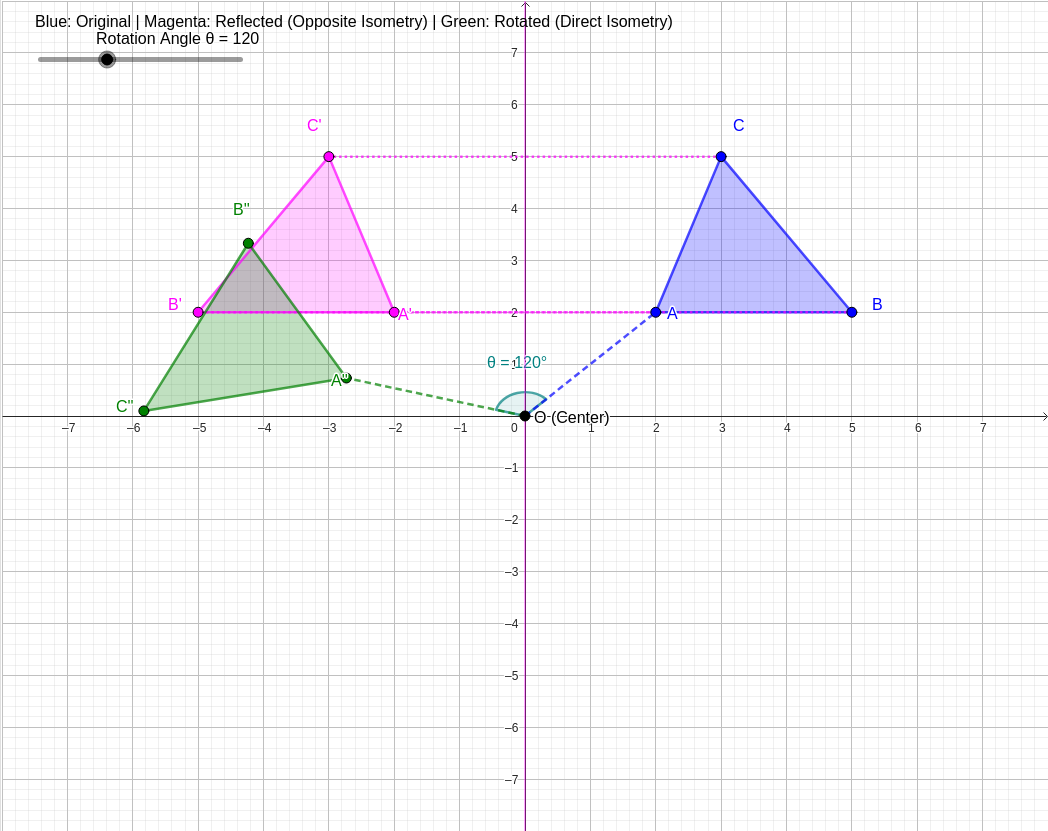
Question: Visualize reflection and rotation of a shape
Geometric Transformations: Reflection and Rotation
In Euclidean geometry, isometries (or rigid transformations) are operations that move a shape without altering its size or internal angles. The two fundamental planar isometries are reflection and rotation.
1. Reflection (Flipping across a Line)
A reflection maps every point of a figure across a fixed line, known as the line of reflection (mirror line).
- Perpendicular Bisector Property: For any point and its reflected image , the mirror line is the perpendicular bisector of the segment . That is:
- Reversal of Orientation: Reflection is an opposite isometry. If the vertices of the original triangle are traversed in a clockwise order, the reflected vertices will appear in a counterclockwise order.
2. Rotation (Turning about a Point)
A rotation turns every point of a figure around a fixed point, called the center of rotation
, through a specified angle of rotation
.
- Distance Preservation: Every point and its rotated image remain at the exact same distance from the center:
- Constant Angle: The angle formed by connecting to the center and then to is constant for all points on the shape:
- Preservation of Orientation: Rotation is a direct isometry. The cyclic ordering of vertices remains unchanged (a clockwise triangle remains clockwise).
Key Elements in the Interactive Diagram
- Original Shape (Blue, ): An asymmetric triangle located in the first quadrant.
- Line of Reflection (Dashed Magenta, -axis): The mirror axis.
- Reflected Shape (Magenta, ): The flipped image with reversed orientation. Dotted segments show that each vertex pair , , is equidistant from the mirror line.
- Center of Rotation ( , Origin): The pivot point at .
- Rotated Shape (Green, ): The rotated image controlled by the angle slider . Circular paths and angle markers trace the motion of the vertices.