Parabolic Cylinder z = x^2 and Plane y = 3x - 1
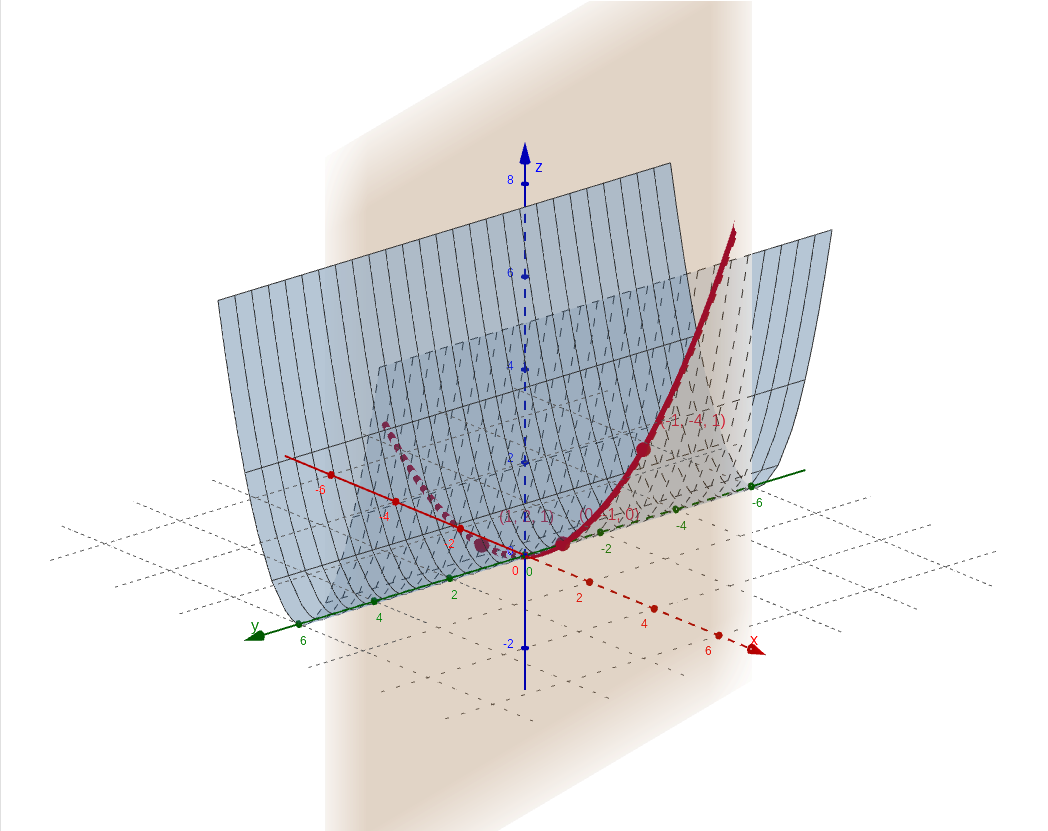
Question: Visualise me surface of function f(x)= x^2, y=3x-1
Understanding the 3D Surfaces and Their Intersection
In three-dimensional space with Cartesian coordinates
:
1. The Parabolic Cylinder:
- The equation defines a standard upward-opening parabola in the -plane with its vertex at the origin .
- Because the variable is completely absent from the equation, the value of does not depend on .
- Translating this parabola along the entire -axis sweeps out a trough-shaped surface known as a parabolic cylinder (rendered in translucent blue).
2. The Vertical Plane:
- The linear relation (or ) represents a straight line in the two-dimensional -plane with a slope of and a -intercept of .
- In three dimensions, since is unrestricted, this line extends infinitely upwards and downwards parallel to the -axis, forming a flat vertical plane (rendered in translucent amber/orange).
3. The Curve of Intersection
When the vertical plane cuts through the parabolic cylinder, their simultaneous solution forms a space curve:
- Parameterizing using :
- This intersection (highlighted by the thick crimson curve) is a parabola tilted in three dimensions lying entirely on the plane .
Key points on the intersection curve include:
- When : Point
- When : Point
- When : Point
The interactive 3D visual diagram below illustrates the blue parabolic cylinder
, the intersecting amber plane
, and the crimson curve marking their intersection.