Vertical Angles Support Bars
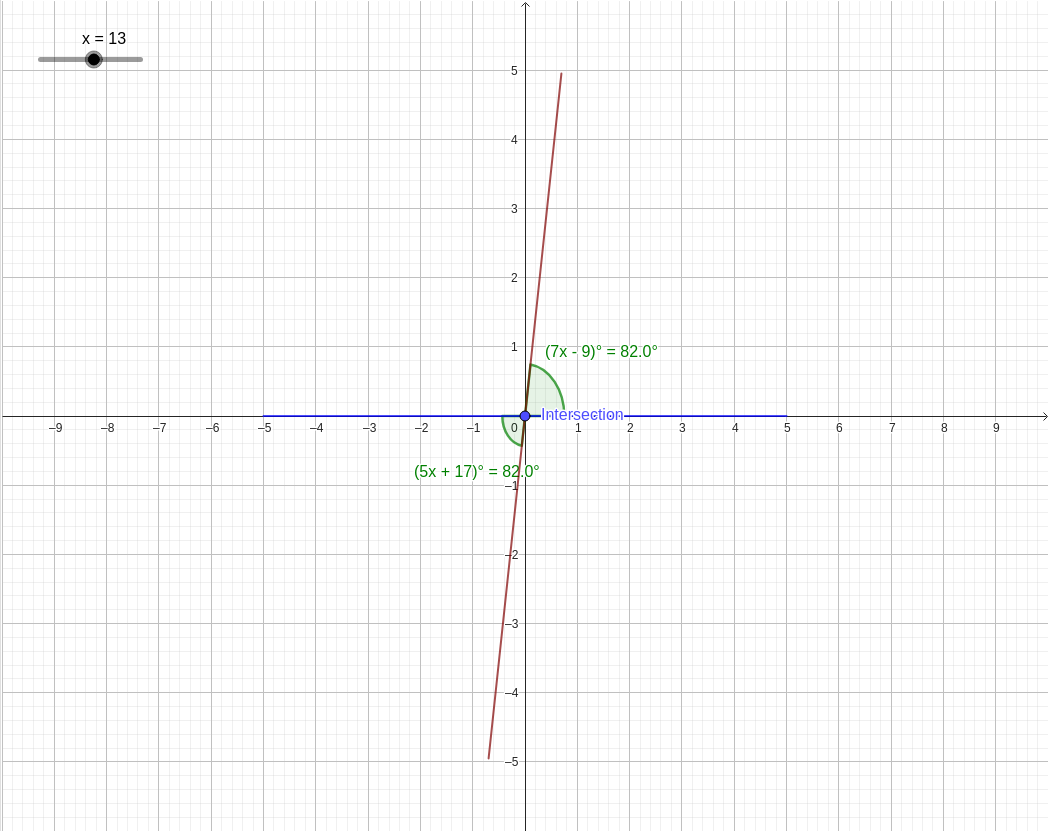
Question: Two support bars intersect. A pair of vertical angles are labeled (7x - 9)° and 5x + 17)°.
Vertical angles are a pair of non-adjacent angles formed by the intersection of two straight lines. A fundamental theorem in geometry states that vertical angles are always equal in measure.
When two support bars intersect, they create two pairs of vertical angles. In this problem, we are given the algebraic expressions for one such pair:
- Angle 1:
- Angle 2:
Since these are vertical angles, we can set their expressions equal to each other to solve for the unknown variable
.
Step-by-Step Solution
1. Set up the equation: Because vertical angles are congruent, their measures are equal:
2. Isolate the
terms: Subtract
from both sides of the equation:
3. Isolate the constant terms: Add 9 to both sides:
4. Solve for
: Divide both sides by 2:
5. Find the measure of the angles: Substitute
back into either expression to find the actual degree measure:
Both angles measure
, confirming that they are indeed equal. In the diagram below, you can use the slider to adjust the value of
. Notice how the two expressions only produce the same numerical value when
is exactly 13, which is the point where the geometric model of the intersecting bars is consistent with the algebra.