Triangle Centers Ortho Circum
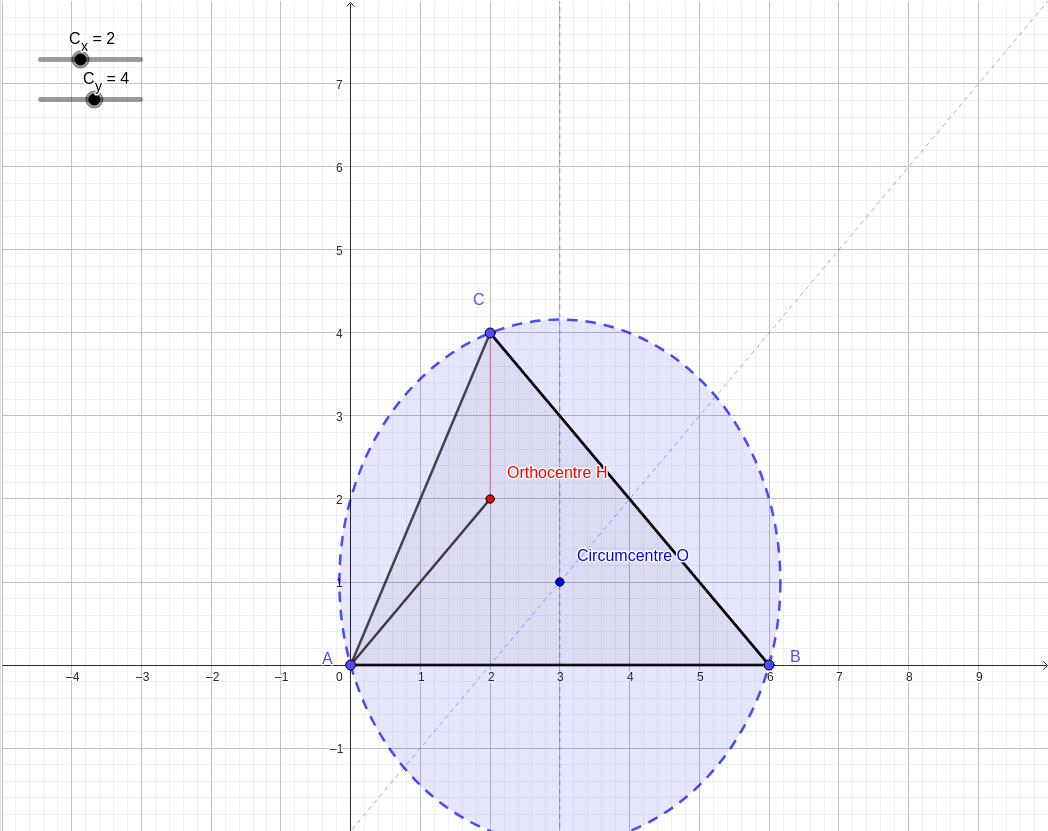
Question: Find the orthocentre and circumcentre of a triangle
In coordinate geometry, the properties of a triangle are defined by its vertices. The orthocentre and circumcentre are two of the four classical centres of a triangle.
1. The Circumcentre ( )
The circumcentre is the point where the three perpendicular bisectors of the sides of the triangle intersect. It is the centre of the circle that passes through all three vertices (the circumcircle).
- Property: The circumcentre is equidistant from all three vertices , , and . [perp. bisector of chord]
- Method:
- Find the midpoints of two sides of the triangle.
- Find the slopes of these two sides.
- Determine the slopes of the perpendicular bisectors using .
- Form the equations of the perpendicular bisectors.
- Solve the equations simultaneously to find the intersection point .
2. The Orthocentre ( )
The orthocentre is the point where the three altitudes of the triangle intersect. An altitude is a line segment through a vertex and perpendicular to the opposite side.
- Property: The line from a vertex to the orthocentre is perpendicular to the opposite side. [altitude of ]
- Method:
- Find the slopes of two sides of the triangle.
- Determine the slopes of the altitudes (perpendicular to those sides) using .
- Form the equations of the altitudes passing through the opposite vertices.
- Solve the equations simultaneously to find the intersection point .
Example Derivation
Consider a triangle with vertices
,
, and
.
(a) Finding the Circumcentre
Midpoint of
.
Since
lies on the x-axis, its perpendicular bisector is a vertical line:
Midpoint of
.
Slope of
:
Slope of perpendicular bisector of
:
Equation of perpendicular bisector of
:
Substitute (1) into (2):
The circumcentre is
.
(b) Finding the Orthocentre
Altitude from
to
:
Since
is on the x-axis, the altitude from
is a vertical line:
Altitude from
to
:
We found
, so the slope of the altitude is
.
Equation of altitude from
:
Substitute (3) into (4):
The orthocentre is
.
In the interactive diagram below, you can move vertex
to see how the orthocentre (red) and circumcentre (blue) change their positions relative to the triangle. Note that for an obtuse triangle, these centres lie outside the triangle, whereas for a right-angled triangle, the orthocentre coincides with the vertex at the right angle and the circumcentre is the midpoint of the hypotenuse.