Tangent Properties from an External Point
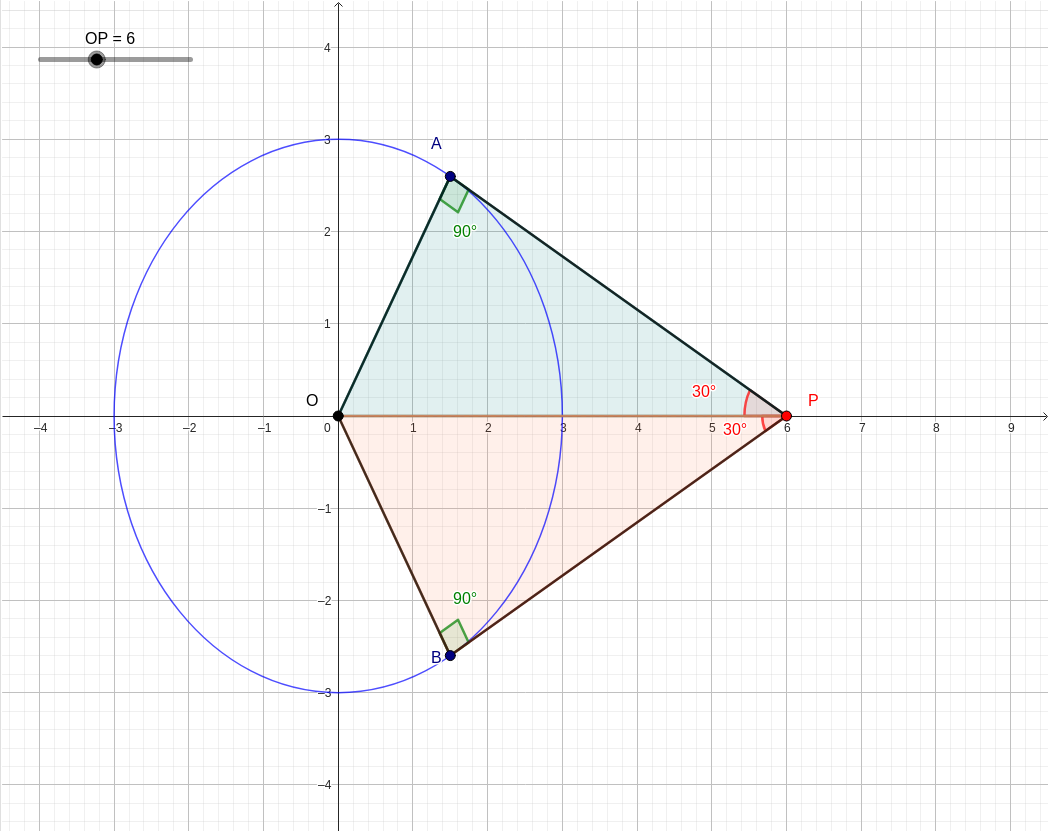
Question: Explain tangent properties from an external point
Tangent Properties from an External Point
When two tangent lines are drawn from an external point
to a circle centered at
, several fundamental geometric properties arise from the resulting symmetry and triangle congruence.
1. The Right-Angle Property (Radius Tangent)
A tangent line touches a circle at exactly one point (the point of contact). The radius drawn to the point of contact is always perpendicular to the tangent line at that point:
2. Congruence of the Tangent Triangles ( )
Connecting the external point
to the center
divides the figure into two right-angled triangles,
and
:
- Hypotenuse: is common to both triangles.
- Legs (Radii): (both are radii of the circle).
- Right Angles: .
By the RHS (Right angle-Hypotenuse-Side) congruence criterion:
3. Key Deductions from Congruence
A. Equal Tangent Lengths
Corresponding sides of congruent triangles are equal in length:
The lengths of the two tangents drawn from an external point to a circle are always equal.
B. Angle Bisector of the External Angle
The line of centers
bisects the angle between the two tangents:
C. Angle Bisector of the Central Angle
The line of centers
also bisects the angle subtended by the points of contact at the center:
4. Supplementary Angles & Cyclic Quadrilateral
In quadrilateral
, the sum of all interior angles is
:
- The central angle and the external angle are supplementary.
- Since the opposite angles sum to ( and ), quadrilateral is a cyclic quadrilateral.
Visual Diagram Elements
- Circle (Black): Centered at with radius .
- External Point & Contact Points : and form equal tangent segments.
- Right-Angle Markers (Red): Display and .
- Congruent Regions (Blue / Orange): Shaded and .
- Line of Centers (Dashed Blue): Acts as the axis of symmetry and angle bisector.