Sum To Infinity Sequence
Question: Find the sum to infinity of a geometric sequence
Sum to Infinity of a Geometric Sequence ( )
In HKDSE Mathematics (Compulsory Part), a geometric sequence (G.S.) has a first term
and a common ratio
. The general
-th term is given by:
1. Derivation of the Sum to Infinity
The sum of the first
terms of a geometric sequence is:
When we add infinitely many terms, we examine the behavior of
as
becomes very large (
):
- Condition for Convergence: The sum to infinity exists if and only if
- When , the term gets closer and closer to as increases:
Substituting
into the sum formula gives the Sum to Infinity Formula:
(Note: If
and
, the terms do not shrink towards zero, so the series diverges and
does not exist.)
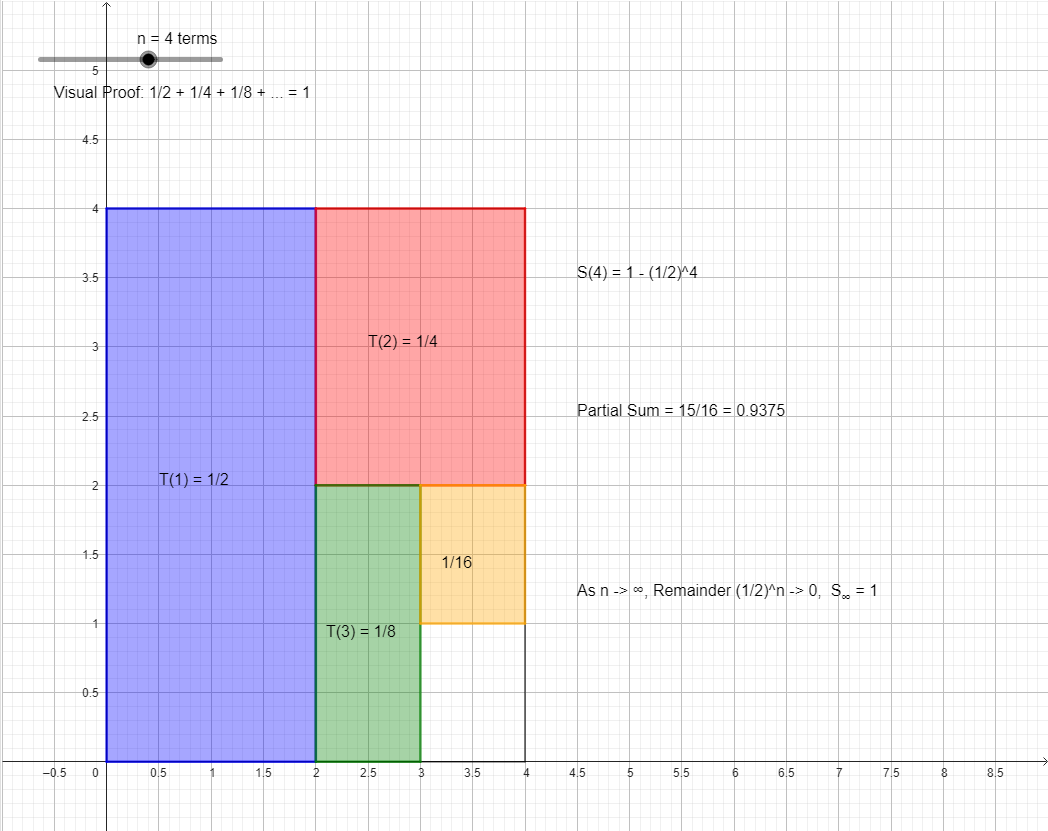
2. Geometric Interpretation: Visualizing
Consider a square with side length
(total
):
- Cut the square in half vertically Area
- Cut the remaining half horizontally Area
- Cut the remainder vertically Area
- Continuing infinitely fills the entire square of area :
3. Standard HKDSE Exam Types & Marking Criteria
Type A: Direct Calculation
Example: In a geometric sequence, the 1st term is and the 3rd term is . If all terms are positive, find the sum to infinity.
Type B: Converting Recurring Decimals to Exact Fractions
Example: Express as a simplified fraction.
This is an infinite geometric series with
and
:
Key Summary Checklist for HKDSE
| Feature | Rule / Condition | ||
|---|---|---|---|
| Formula | |||
| Condition | (Mandatory check in Paper 2 MC) | ||
| Common Traps | Forgetting that is undefined when $ | r | \ge 1$ |
| Rounding | Exact fraction or significant figures unless specified |
The interactive diagram below demonstrates how successively adding terms of
completely fills the unit square towards
.