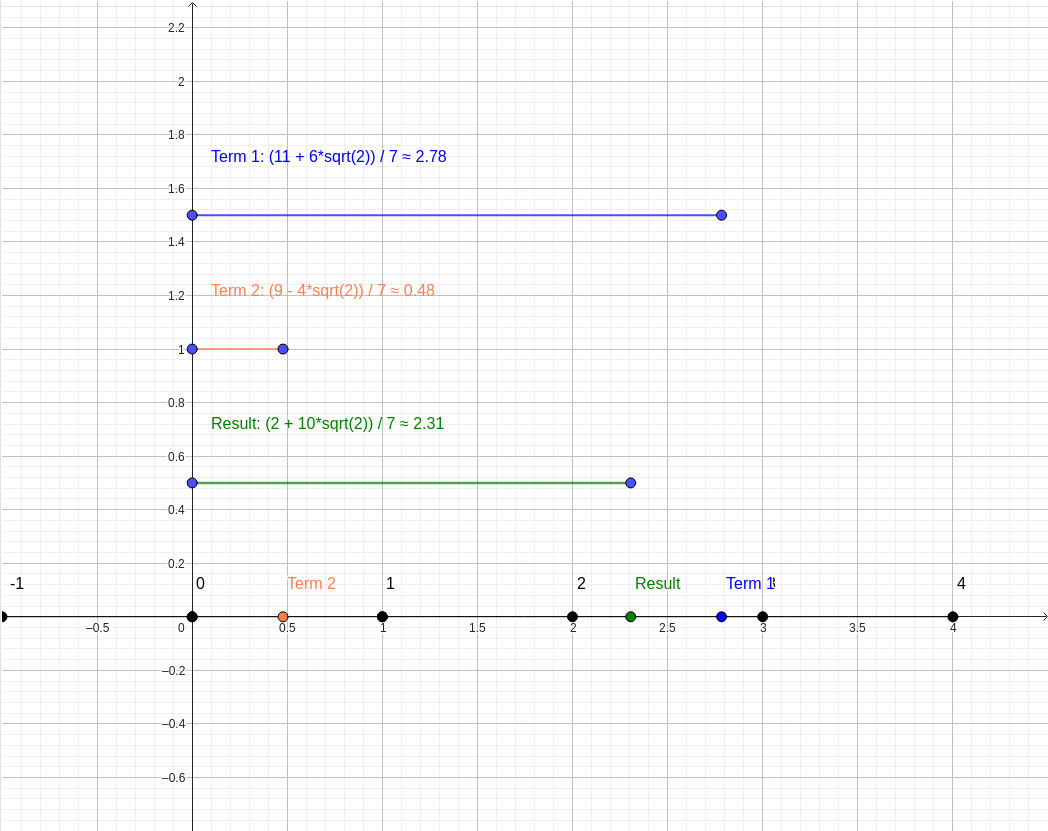
To simplify the algebraic expression:
\frac{3 + \sqrt{2}}{3 - \sqrt{2}} - \frac{4 - \sqrt{2}}{4 + \sqrt{2}}
we rationalize the denominator of each fraction by multiplying the numerator and denominator by the conjugate of the denominator.
Step 1: Rationalize the first fraction
The conjugate of
3 - \sqrt{2} is
3 + \sqrt{2}.
\begin{align*} \frac{3 + \sqrt{2}}{3 - \sqrt{2}} &= \frac{(3 + \sqrt{2})(3 + \sqrt{2})}{(3 - \sqrt{2})(3 + \sqrt{2})} \\ &= \frac{3^2 + 2(3)(\sqrt{2}) + (\sqrt{2})^2}{3^2 - (\sqrt{2})^2} \\ &= \frac{9 + 6\sqrt{2} + 2}{9 - 2} \\ &= \frac{11 + 6\sqrt{2}}{7} \end{align*}
Step 2: Rationalize the second fraction
The conjugate of
4 + \sqrt{2} is
4 - \sqrt{2}.
\begin{align*} \frac{4 - \sqrt{2}}{4 + \sqrt{2}} &= \frac{(4 - \sqrt{2})(4 - \sqrt{2})}{(4 + \sqrt{2})(4 - \sqrt{2})} \\ &= \frac{4^2 - 2(4)(\sqrt{2}) + (\sqrt{2})^2}{4^2 - (\sqrt{2})^2} \\ &= \frac{16 - 8\sqrt{2} + 2}{16 - 2} \\ &= \frac{18 - 8\sqrt{2}}{14} \end{align*}
Simplify by dividing the numerator and the denominator by
2:
\begin{align*} \frac{18 - 8\sqrt{2}}{14} &= \frac{9 - 4\sqrt{2}}{7} \end{align*}
Step 3: Subtract the two fractions
Now combine both terms over their common denominator,
7:
\begin{align*} \frac{11 + 6\sqrt{2}}{7} - \frac{9 - 4\sqrt{2}}{7} &= \frac{(11 + 6\sqrt{2}) - (9 - 4\sqrt{2})}{7} \\ &= \frac{11 + 6\sqrt{2} - 9 + 4\sqrt{2}}{7} \\ &= \frac{(11 - 9) + (6\sqrt{2} + 4\sqrt{2})}{7} \\ &= \frac{2 + 10\sqrt{2}}{7} \end{align*}
Final Answer