Pyramid Cross-Section Ratio SQ/SD
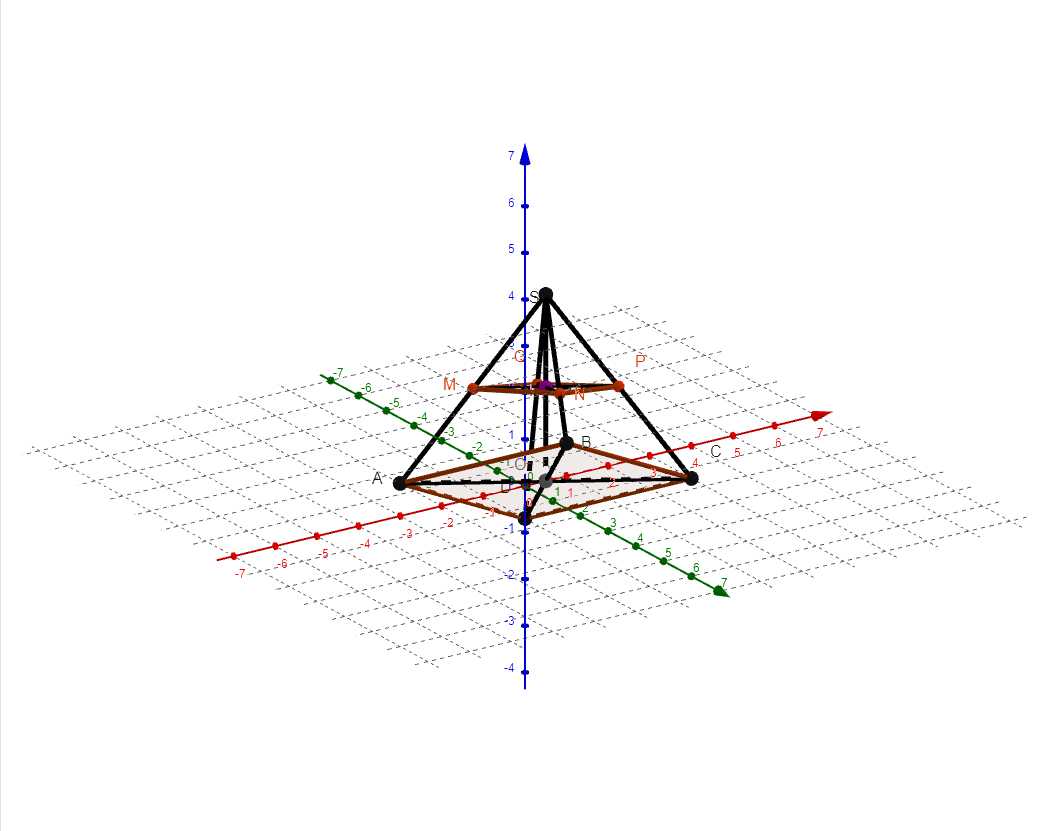
Question: Question 14: Given the pyramid S.ABCD, whose base ABCD is a parallelogram. Let M and P be the midpoints of SA and SC, respectively. Point N lies on SB such that \frac{SN}{SB}=\frac{2}{3}. Let Q be the intersection of SD and the plane (MNP). Find the ratio \frac{SQ}{SD}.
To find the ratio
, we use the intersection properties of diagonal planes in a pyramid with a parallelogram base.
Step-by-Step Solution
1. Find the intersection of and the altitude/median
Let
be the center of the base parallelogram
. Therefore,
is the midpoint of both diagonals
and
.
In
:
- is the midpoint of .
- is the midpoint of .
Thus,
is the midline of
, which means:
- bisects the median segment at a point .
Therefore,
is the midpoint of
, so:
2. Determine the intersection
Since
, the point
lies in the plane
.
Notice that the line segment
lies in the diagonal plane
. Therefore:
- Both points (on ) and (on ) lie in the plane .
- The line lies completely within the plane and also within the plane .
Extending
in the plane
intersects the lateral edge
at the point
.
3. Calculate the ratio using Coplanarity / Ratio Relation
For any pyramid
whose base is a parallelogram, if a plane cuts the four lateral edges
at points
respectively, the following relation holds:
Substitute the given ratios into the formula:
Taking the reciprocal gives: